Tang Band W5-2143 Full Range
Fig 1 is the RAW response of the Tang Band W5-2143 in a 6 liters sealed box. In the manufacturer’s plot at the top, the response is flat. My measurement is anything but that. The reason for this discrepancy is because manufacturers measure their drivers using an IEC Baffle which is 165cm x 135cm. Now unless your loudspeaker’s front baffle is that large, the response won’t be flat. When the front baffle’s width is reduced to 8″, the response will be Fig 1. Let’s take a closer look at the “Real” response. Most notably is the rise from 1kHz~7kHz culminating with a 5dB elevation in the middle. This characteristic is due to what is called “Baffle Step”. There’s no running away from it. The effect is an over-emphasis in the upper midrange and lower treble. If left unattended, the vocals will sound “shouty”. One will get tired of listening to the music after a while, hence the term “listener fatigue”.
The next measurement is the Harmonic Distortion in Fig 2. It is not as low as my 2-ways but for a full range, it’s acceptable. Without a tweeter, the rise in the treble is expected. What is more important to me is whether I can hear this distortion. After auditioning this Tang Band W5-2143 for weeks, not once were my ears irritated, so the driver is not an issue.
In Fig 3, we can see the behavior of the W5-2143. Theoretically, a woofer’s cone moves forward and after the peak, it moves back and stops completely. Unfortunately, in real life, that never happens. The light blue slices are the “Stored Energy”. In other words, the woofer is still be producing sound. The bunch of stored energy at 10kHz are the artifacts generated by the peak at 10kHz seen in Fig 1. They may seem a lot but as you will see later, it’s really not that serious because the z-axis of this plot is in cycles.
The Waterfall plot in Fig 4 shows the treble artifacts when the z-axis is in time instead of cycles. At 10kHz, it drops 20dB by 1.5ms. I didn’t pick up this 10kHz peak so I don’t need to attend to it. If I want some bragging rights, I can always EQ it away in my crossover.
The Spectrogram (Fig 5) is a 2D representation of the W5-2143 response. The excess energy at 10kHz doesn’t even last 1ms. That’s why I said earlier I won’t lose any sleep over it. The measurements are at micro level. Human hearing cannot resolve to that level. The Spectrogram recorded some streaks at 1.2kHz and 2kHz. These are the light blue slices from 1kHz~5kHz in the Toneburst plot shown in Fig 3. By 6ms, they are -50dB from the fundamental. As far as I’m concern, they are not there.
It is in the Step Response (Fig 6) that attracted me to full range drivers. This is close to what speakers like Thiel is famous for, Time & Phase Coherent. To do this in a 2-way or worse still, a 3-way is quite daunting. Since there’s no need for a tweeter in a full range driver, there’s no phase displacement in the treble. Summary One may be tempted to design a bass reflex with this Tang Band W5-2143 but with only 2.5mm X-max, using an electronic EQ to boost the bass is not a good practice. Neither is designing a -10dB Baffle Step Compensation (BSC) in the crossover appealing. That leaves either a horn loaded design, a Transmission Line (TL) or use a woofer to supplement the bass. For simplicity, I will adopt this latter approach. Readers would have wondered why was I spending so much time and money testing 8″ woofers. Well, it’s precisely for this. Finding the best woofer to support a full range. The woofer I’ve chosen to handle the bass is the HiVi F8. This woofer has the best price/performance ratio. In the next post, I’ll show how they all come together. Unless otherwise stated, all measurements were made in Full Space (4pi). Mic at 36 ins, tweeter axis. Impulse Window=5ms. No smoothing applied. |

August 18, 2024Drivers Thiele & Small, HIFI DRIVERS
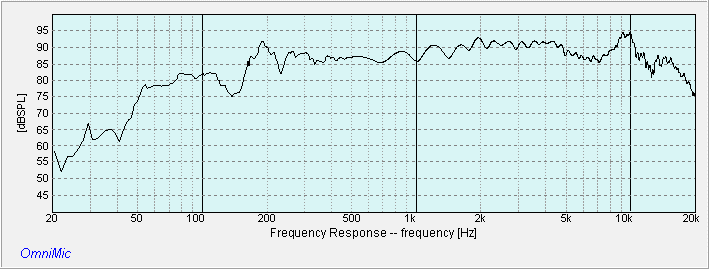 Fig 1 – W5-2143 RAW Response • 6 Liters Sealed Box • Baffle Width = 8″
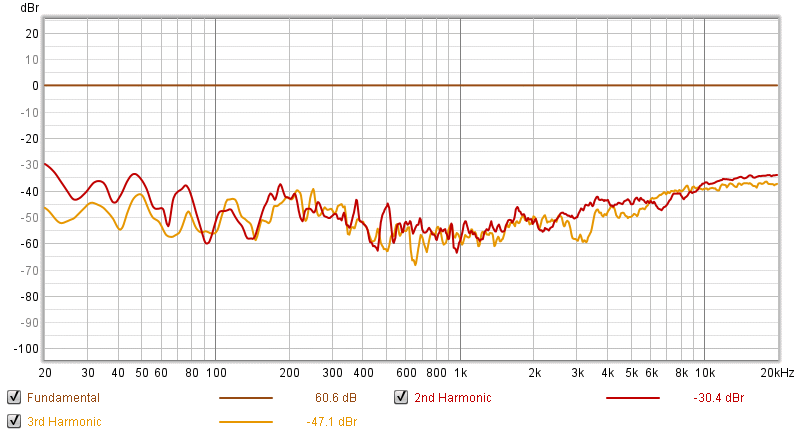 Fig 2 – W5-2143 Harmonic Distortion
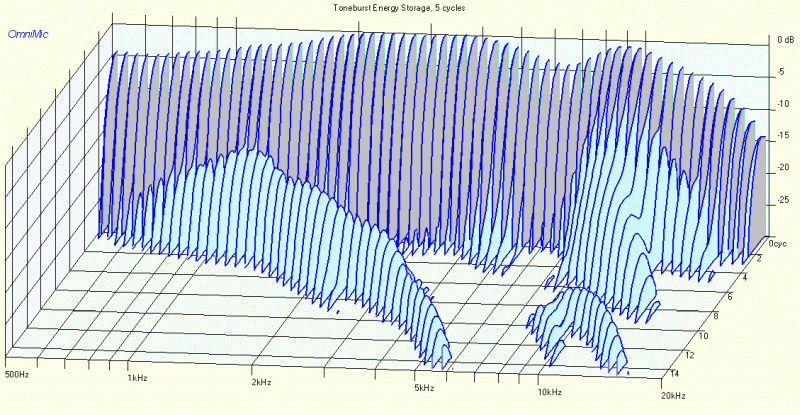 Fig 3 – W5-2143 Toneburst Energy Storage
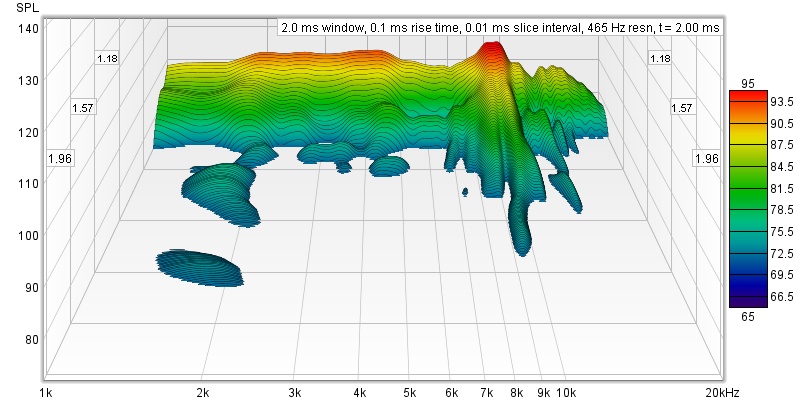 Fig 4 – W5-2143 Waterfall
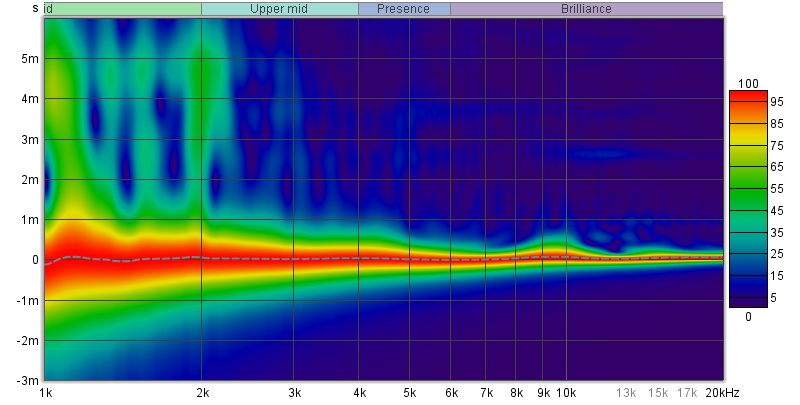 Fig 5 – W5-2143 Spectrogram
 Fig 6 – W5-2143 Step Response