Finch-II (Natural Music)
Wavecor TW030WA12 with HiVi F8
The Finch-II follows the tradition of the Finch in that she is a minimalist design. By that, I mean as little crossover components as humanly possible. Designs like this use 1st order filters which have their advantages but at the same time, are subjected to the unevenness of the driver’s frequency response.
What made me decide to work on this minimalist design again is the Wavecor TW030WA12 tweeter. She is the only tweeter that is capable of crossing at a low of 1.5kHz. The Morel CAT378 that I used in the Finch is unable to do that. That’s why I had to use a 6-1/2″ Vifa PL18 midwoofer. With this Wavecor tweeter, I can use a larger woofer, hence the HiVi F8.
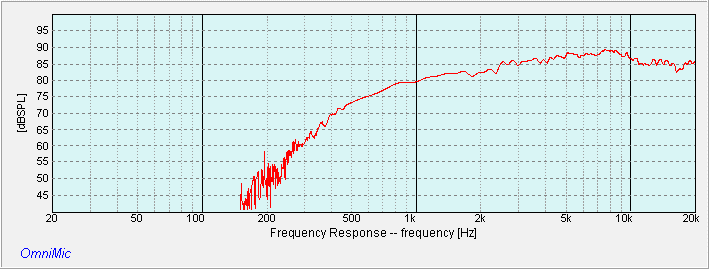 Fig 1 – Wavecor TW030WA12-8 with high Pass Filter (Flush Mounted) Fig 1 – Wavecor TW030WA12-8 with high Pass Filter (Flush Mounted)
Fig 1 is the response of the TW030 with a single capacitor for High Pass. She is incredibly flat when flush mounted. There are no signs of baffle diffraction.
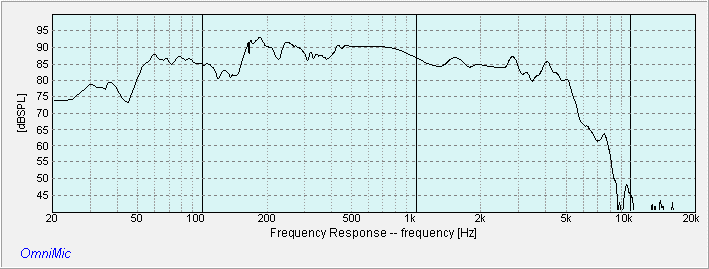 Fig 2 – HiVi F8 with Low Pass Filter Fig 2 – HiVi F8 with Low Pass Filter
Fig 2 is the frequency response of the HiVi F8 with a single inductor. Immediately, I can see I will face some issues. There are two peaks just before the woofer rolls-off. They will interfere with the summing of the tweeter.
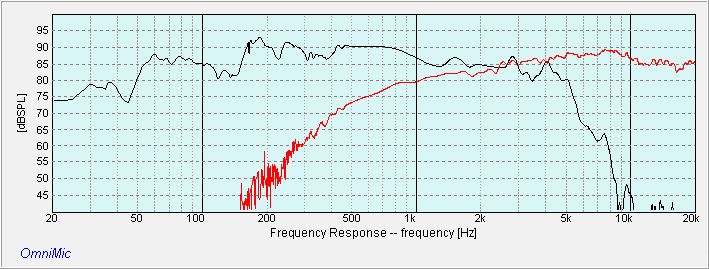 Fig 3 – HiVi F8 Low Pass & Wavecor TW030 High Pass Fig 3 – HiVi F8 Low Pass & Wavecor TW030 High Pass
Fig 3 shows the individual responses of the two drivers. The peaks of the F8 are touching the tweeter response, so I can expect some cancellations. I can easily avoid this by using a higher order filter but I’ll leave that for another day. Right now, I’m sticking to 1st order.
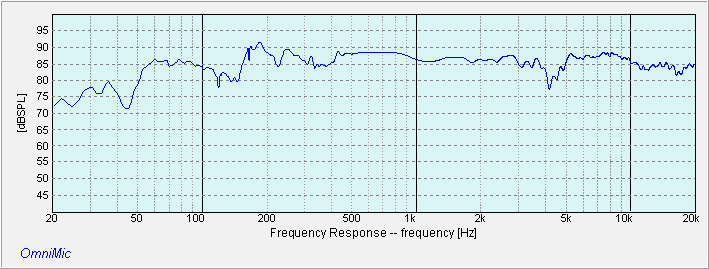 Fig 4 – Finch-II Frequency Response (No Smoothing) Fig 4 – Finch-II Frequency Response (No Smoothing)
The summed response of the HiVi F8 with the Wavecor TW030 is in Fig 4. Due to the peak in the F8, it resulted in a notch at 4kHz. Don’t be mistaken that this is the crossover frequency of the two drivers. It is not as we will see later.
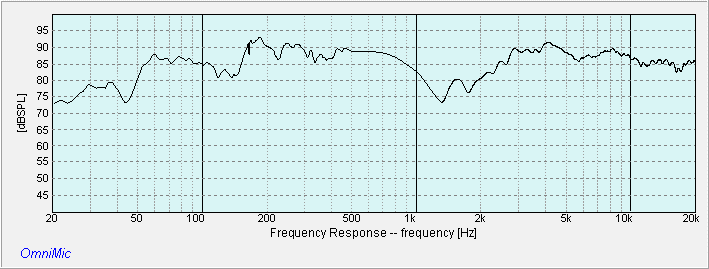 Fig 5 – Finch-II Null Fig 5 – Finch-II Null
The frequency where the F8 and the TW030 are crossing is actually about 1.3kHz (Fig 5), not 4kHz shown in Fig 4. This null response is with the two drivers wired in-phase. Some people have the wrong impression that 1st order filters are phase aligned, therefore both drivers must be wired in-phase. That is only true when you are working in electronics. With loudspeakers, it’s totally different. There is a thing called acoustic centers.
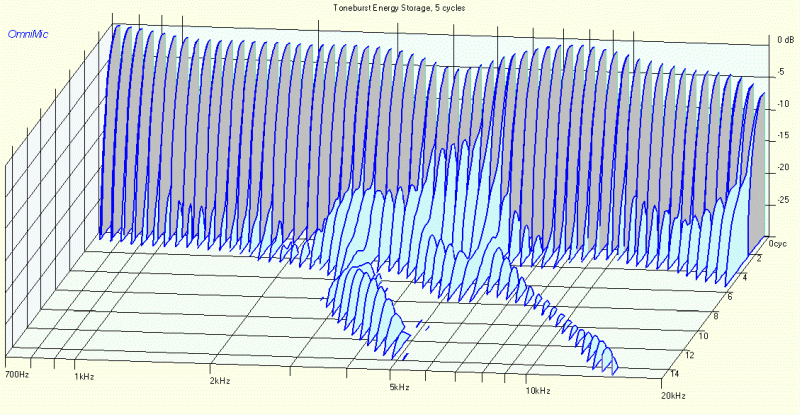 Fig 6 – Finch-II Toneburst Energy Storage Fig 6 – Finch-II Toneburst Energy Storage
The Toneburst plot (Fig 6) is surprisingly good. The tweeter is exceptionally clean. That bunch of stored energy (light blue slices) at 4kHz is caused by the peak of the HiVi F8.
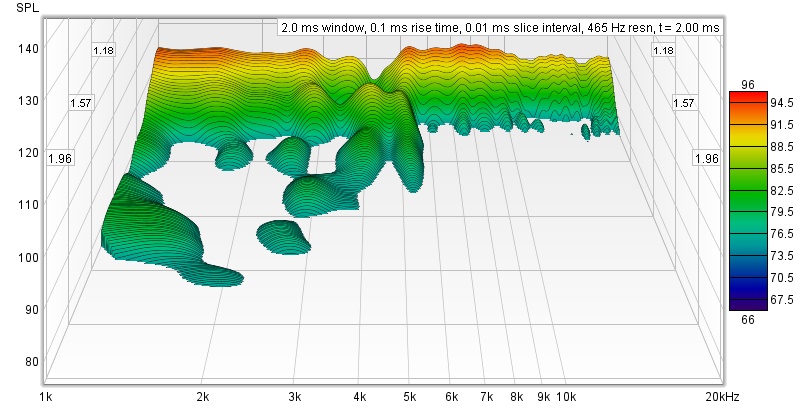 Fig 7 – Finch-II Waterfall Fig 7 – Finch-II Waterfall
The Waterfall plot in Fig 7 shows the artifacts at 4kHz. In the upper treble, there’s hardly any. This is what a high-end tweeter looks like.
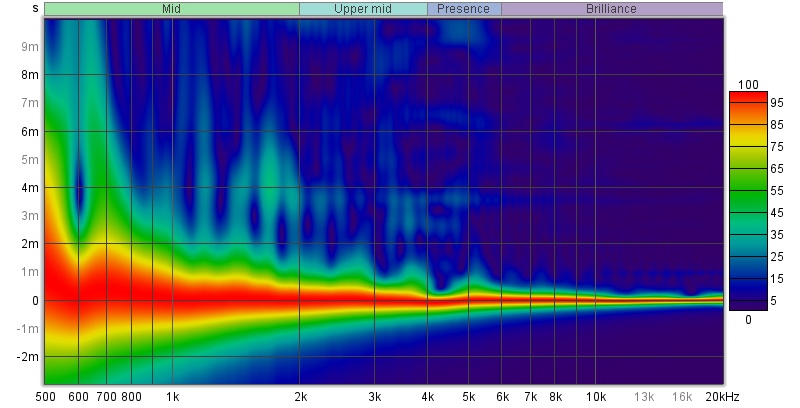 Fig 8 – Finch-II Spectrogram Fig 8 – Finch-II Spectrogram
The Spectrogram in Fig 8 is a 2-D representation of the Toneburst and Waterfall plots. There are very little artifacts from 1kHz upwards. Below that are two streaks but their energy is dissipated by 8ms.
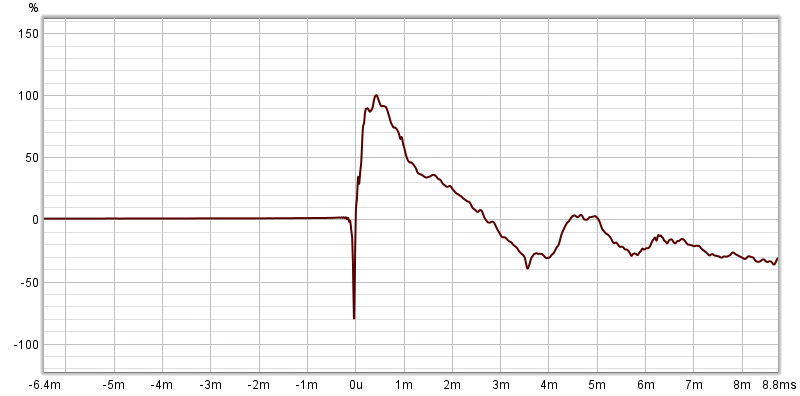 Fig 9 – Finch-II Step Response Fig 9 – Finch-II Step Response
Astute readers would know that I wired the tweeter in reversed phase (Fig 9). That’s the first sharp negative step. Immediately after is the woofer wired in-phase. The attack of the F8 is pretty fast. Though the tip at the apex is about 400us, her her initial peak is at 200us or less. For an 8″ woofer, that’s impressive.
 Fig 10 – Finch-II Distortion Fig 10 – Finch-II Distortion
The Finch-II Harmonic Distortion (Fig 10) is quite low. 2nd harmonic is at -46.4dBr while the 3rd is even lower at -58.0dBr. Whatever distortion from the HiVi F8 cone breakup will not be heard.
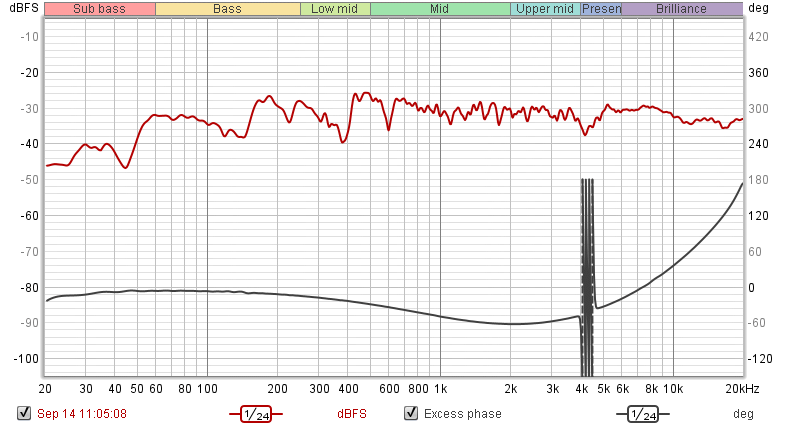 Fig 11 – Finch-II Excess Phase Fig 11 – Finch-II Excess Phase
The Finch-II Excess Phase is in Fig 11. It recorded some glitches at 4kHz. They are not phase reversals caused by the crossover. Rather, they are from the HiVi F8 peak. Ignoring the glitches, the Excess Phase is one smooth continuous plot.
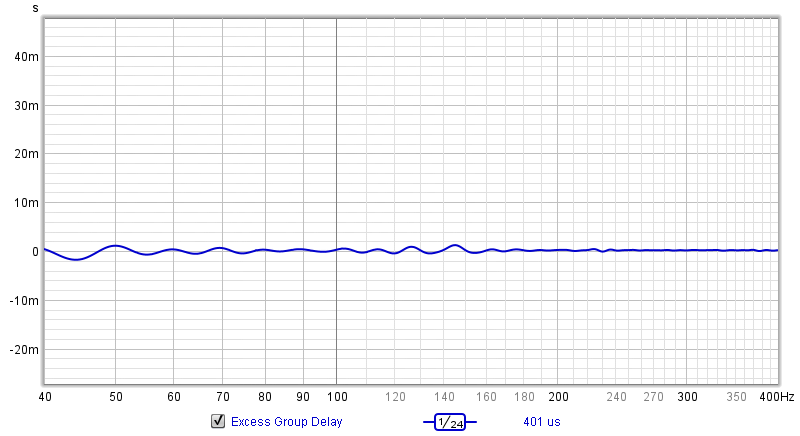 Fig 12 – Finch-II Excess Group Delay Fig 12 – Finch-II Excess Group Delay
The Excess Group Delay for the Finch-II is -401us (Fig 12). You will not hear the bass lagging the midrange with this figure. That’s the beauty of using 1st order filters.
Summary
How does this Finch-II sound like? Well for one, the treble is marvelous. Very sweet, no harshness. Incredible highs. This is now my number one tweeter.
I deliberately crossed her low to get the presence in the midrange. The Wavecor did not complain when I did that. During auditioning, my ears were not irritated by the tweeter’s resonance (Fs).
The midrange is outstanding. Voices and instruments don’t shout at you. After I added the Baffle Step Compensation (BSC), the loudness of the bass improved dramatically. The tonal balance of the Finch-II is perfect.
In use, the bass will be even louder than what I’m hearing now because the Finch-II will be about 14~18 inch away from the floor. Presently, the woofer is 36 inches above the floor and 5 ft away from the back and side walls. This is what is called a Full Space (4pi) placement. Necessary for measurements but quite impractical for home use.
How does this Finch-II compare with the NM series speakers? Even though both uses 1st order networks, the Finch-II is in a different league simply because of the Wavecor tweeter. This TW030WA12 cost close to $100 but she’s worth every penny. Even the Morel CAT378 loses out to her. She’s that good.
Unless otherwise stated, all measurements were made in Full Space (4pi). Mic at 36 ins, tweeter axis. Impulse Window=5ms. No smoothing applied. |
