Osprey BR-II
Eminence Beta 10CX with Celestion CDX1-1446
The Osprey BR-II is a continual development of the Osprey. There are two changes that I made in this version. First, I reduced the Bass Reflex box to 37 liters from the Osprey-BR 45 liters. This is helps greatly in field use. Smaller box, lighter weight.
The second is a major change. I replaced the Selenium D220Ti with a Celestion CDX1-1446. This is the first time I’m using a non-titanium compression driver (CD) in any of my Ospreys. It’ll be interesting to see how this Celestion PETP diaphragm compares to the Selenium D220Ti.
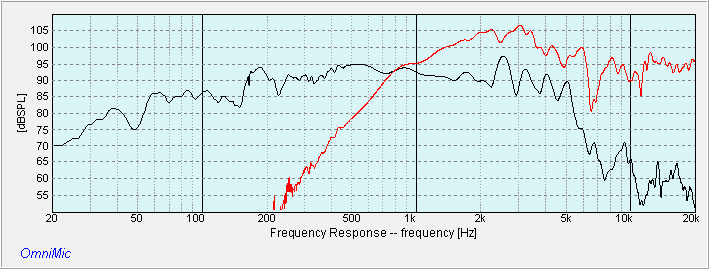 Fig 1 – Beta 10CX (Black plot) • Celestion CDX1-1446 (Red plot) Fig 1 – Beta 10CX (Black plot) • Celestion CDX1-1446 (Red plot)
Fig 1 is the relative loudness of the Beta 10CX and the Celestion CDX1-1446. These are the RAW responses, that is no crossovers are used.
From these plots, it is obvious that the 10CX should be used up to 2kHz only. Beyond that are a series of peaks caused by the cone breakup. For fidelity reasons, we want to avoid these peaks.
Whenever a CD is involved, I always measure the impedance first. It will give me an idea of what I’m up against.
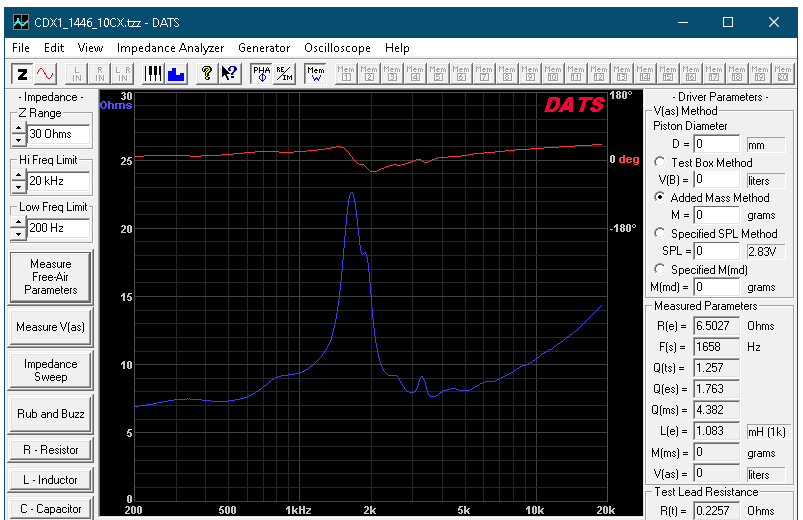 Fig 2 – Celestion CDX1-1446 Impedance Fig 2 – Celestion CDX1-1446 Impedance
Fig 2 is the impedance of the CDX1-1446 screwed to the back of the 10CX. The plot is promising in that there’s only one peak at 1,658Hz (Fs). That makes my life easier.
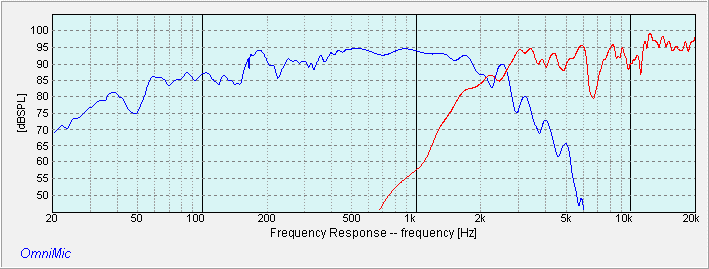 Fig 3 – Beta 10CX (Blue plot) with LP • Celestion CDX1-1446 (Red plot) with HP Fig 3 – Beta 10CX (Blue plot) with LP • Celestion CDX1-1446 (Red plot) with HP
With these measurements in hand, it’s time to work on the crossover. After some adjustments, I came out with the responses that I’m quite happy with. Fig 3 shows the 10CX with a Low Pass network and the Celestion CDX1-1446 with her High Pass. These plots were made with the mic at 36 ins. No smoothing was applied.
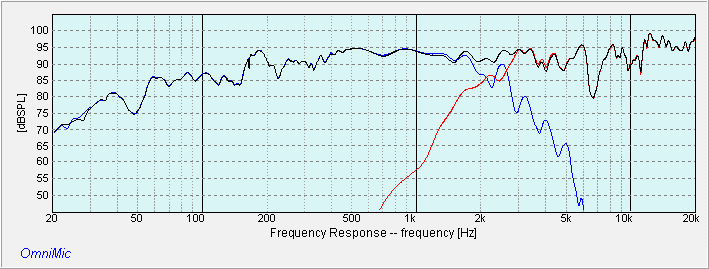 Fig 4 – Summation Fig 4 – Summation
The Black plot (Fig 4) shows the summing in the crossover region. No cancellations are observed on either side of the crossover point.
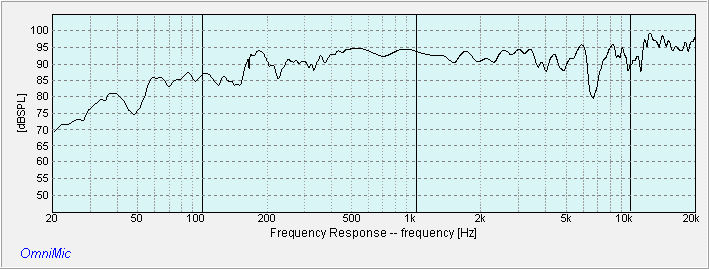 Fig 5 – Osprey BR-II Frequency Response Fig 5 – Osprey BR-II Frequency Response
Fig 5 is the frequency response of the Osprey BR-II (Black plot). Her response is basically flat from 500Hz~10kHz (+/- 2.5dB). There are some cancellations in the treble but there’s nothing I can do about them. The Beta 10CX has a short horn in the center and this is what you get regardless of what CD you use.
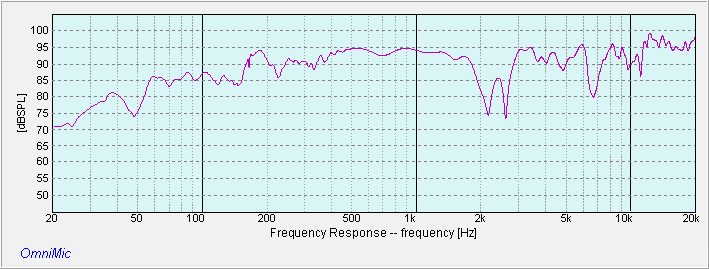 Fig 6 – Osprey BR-II Null Fig 6 – Osprey BR-II Null
Flipping the compression driver’s wires around resulted in a notch (Fig 6). The woofer and the CD are crossing acoustically at 2.5kHz. Normally we’ll see a deep notch but there’s a small peak right in the middle. That’s cause by the 2.5kHz peak seen in the 10CX (Fig 4). If you invert the peak, it’ll result in a deep notch. That’s how phase aligned this Osprey BR-II is.
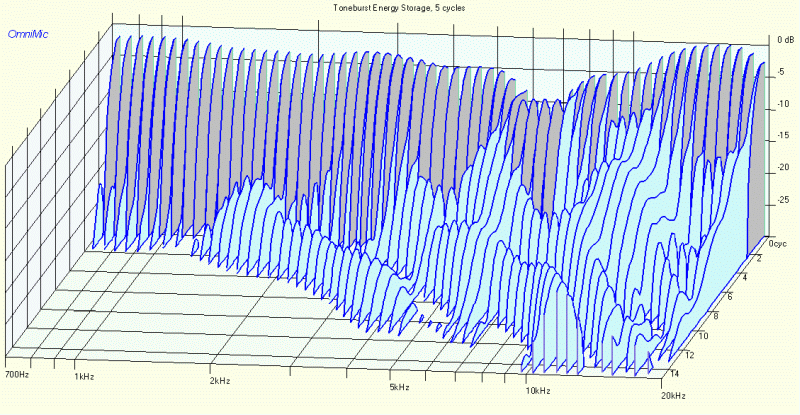 Fig 7 – Osprey BR-II Toneburst Energy Storage Fig 7 – Osprey BR-II Toneburst Energy Storage
The Toneburst plot in Fig 7 shows quite a lot of stored energy (light blue slices) in the treble. It may look bad but in reality they are likely inaudible. Remember in this plot, the z axis is in cycles and not time.
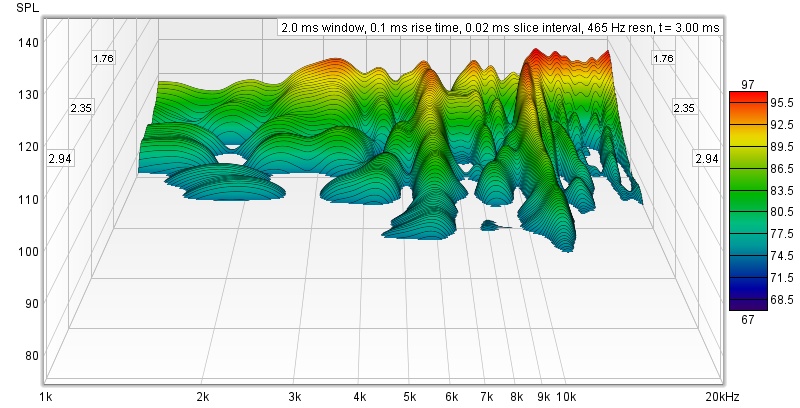 Fig 8 – Osprey BR-II Waterfall Fig 8 – Osprey BR-II Waterfall
In the Waterfall plot (Fig 8), the z-axis is now in time (ms). From this plot, it’s clear that the artifacts are at 6kHz and 12kHz.
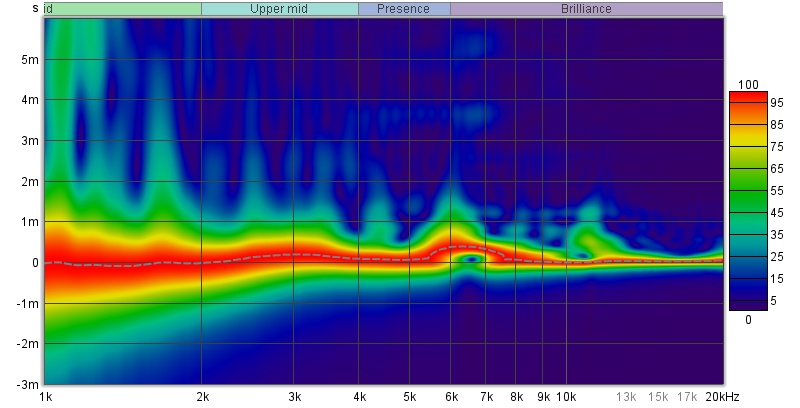 Fig 9 – Osprey BR-II Spectrogram Fig 9 – Osprey BR-II Spectrogram
The Spectrogram (Fig 9) is a 2D representation of the Toneburst and the Waterfall. The artifacts at 6kHz and 12kHz don’t last more than 2ms. As far as I’m concerned, they are inaudible.
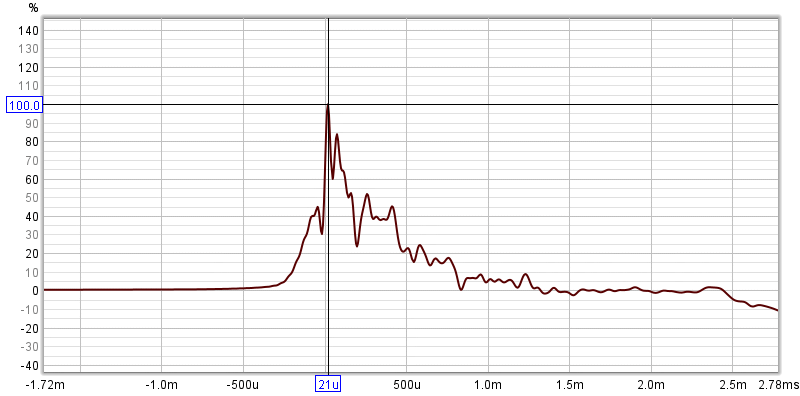 Fig 10 – Osprey BR-II Step Response Fig 10 – Osprey BR-II Step Response
This is where the Osprey BR-II outperforms all others. In the Step response (Fig 10), the woofer and the compression driver are almost time aligned.
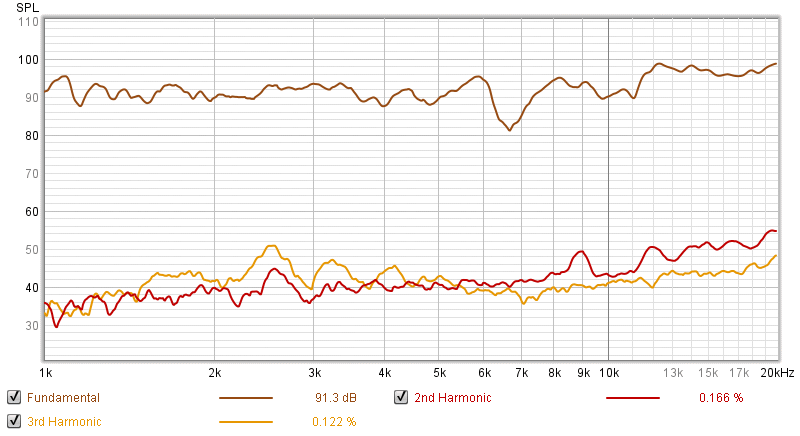 Fig 11 – Osprey BR-II Harmonic Distortion Fig 11 – Osprey BR-II Harmonic Distortion
The plot in Fig 11 recorded low 2nd (0.166%) and 3rd (0.122) harmonic distortions in the Osprey BR-II. This is important because when the distortions are low enough, the artifacts in the treble don’t irritate my ears.
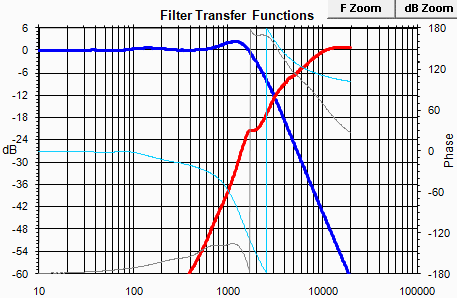 Fig 12 – Osprey BR-II Transfer Function Fig 12 – Osprey BR-II Transfer Function
Fig 12 is the Transfer Function of the Osprey BR-II. This is what the power amplifier sees when connected to the Osprey BR-II. Electrically, the two drivers are crossing at 3kHz (-12dB). This is way above the 2,200Hz recommended in the CDX1-1446 datasheet. I can expect the CD to be able to withstand some abuse. However for professional use, I’ll install a Protection circuit to avoid damaging the CD.
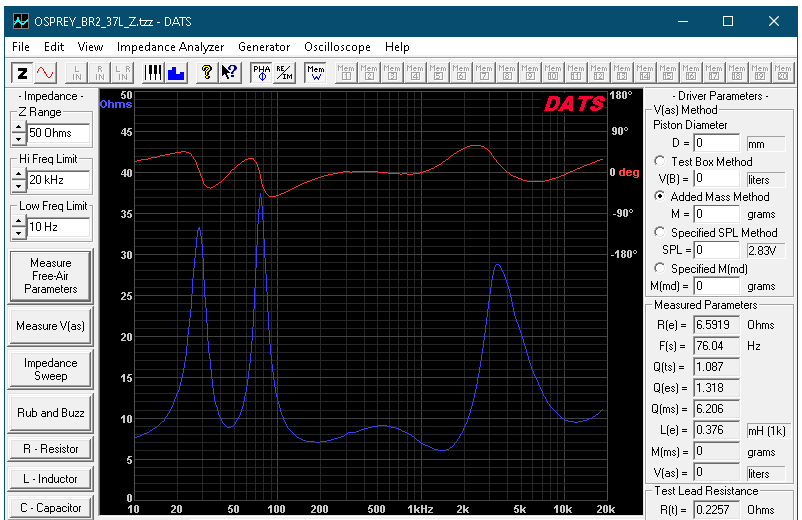 Fig 13 – Osprey BR-II Impedance Fig 13 – Osprey BR-II Impedance
The Osprey BR-II impedance is in Fig 13. The box tuning is exactly from my simulation, spot on at 50hZ. The lowest she goes down to is 6Ω at 1.5kHz. Any power amplifiers that’s rated at 4Ω will not have issues driving her.
Osprey BR-II Sound
The Osprey BR-II sounds very different from the other Ospreys. The first thing I noticed is her treble is exceptionally smooth. There is no brightness that titanium drivers are noted for. The high frequencies are there but when they come on, they don’t draw your attention like titanium drivers do.
The vocals are simply outstanding. Not shouty and no glare. Sibilance is well controlled. The presence in the voices and wind instruments like saxophones sounds natural, not exaggerated.
I voiced the Osprey BR-II for the highest sensitivity (94dB 1W/1m) therefore the bass is not as loud as the midrange because no Baffle Step Compensation is used. If more bass is desired, use a subwoofer or my BassEQ. I developed this kit specially to boost the bass of 2-ways without interfering with the midrange.
In this current configuration, the Osprey BR-II is great for listeners that prefer vocal clarity over bass. Diana Krall, Amanda McBroom, Willie Nelson and others sound superb.
Summary
I’m very pleased with the Celestion CDX1-1446. I’m not a fan of PETP diaphragms but I was won over with this Celestion. It only goes to show that when a driver is well designed, a PETP diaphragm can sound exquisite.
The Osprey BR-II shines in HiFi. Nothing compares to a good coaxial. The music sounds very natural. In PA use, she’s perfect as Stage Monitors and Live Voice reinforcement in churches/schools etc.
I plan to offer a PCB in future. That will help builders that are not accustomed to reading a crossover schematic.
Unless otherwise stated, all measurements were made in Full Space (4pi). Mic at 36 ins, tweeter axis. Impulse Window=5ms. No smoothing applied. |
