Shikra
Dayton MB820-8 with Peavey RX14/Selenium HC23-25
To test out the Selenium HC23-25/Peavey RX14 combo, I decided to mate them with a Dayton MB820-8 woofer. I’ve not heard this Midbass driver before so this test is for both the horn combo as well as the woofer.
The MB820-8 was loaded onto a 24 liters Bass Reflex tuned with a 2″ diameter PVC tube cut to a length of 1-3/4″. Port tuning is 57Hz. Baffle width = 13-1/2″.
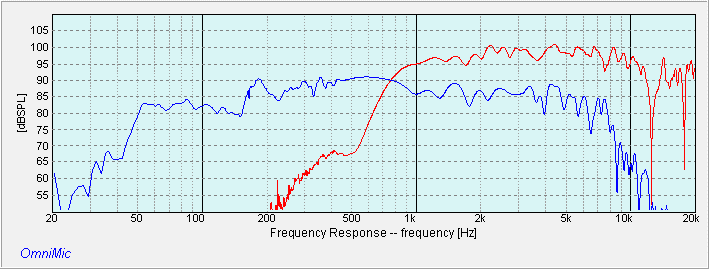 Fig 1 – Dayton MB820-8 Low Pass • RX14/HC2325 High Pass RAW Frequency Responses Fig 1 – Dayton MB820-8 Low Pass • RX14/HC2325 High Pass RAW Frequency Responses
Fig 1 is the relative loudness of the MB820-8 and the HC23-25/RX14 combo. This is their RAW responses, that is no crossovers are used. Microphone is at horn axis.
When I saw these plots, I was a bit concerned whether I will end up with a dip after I sum the two drivers because the MB820 seems to shelve downwards at 1kHz. If I were to cross the horn at 1kHz, it would not be a problem but I’m planning at about 2.5kHz. We’ll see what happens as I go along.
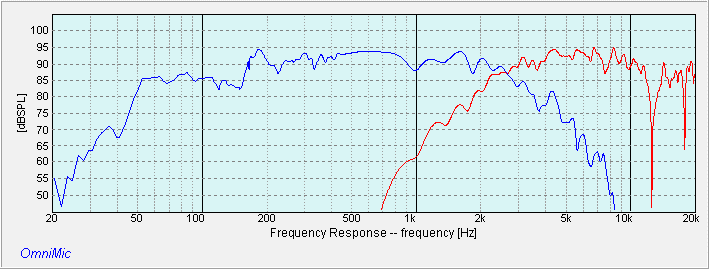 Fig 2 – MB820-8 Low Pass • HC23-25/RX14 High Pass Fig 2 – MB820-8 Low Pass • HC23-25/RX14 High Pass
Fig 2 shows the responses of the woofer (Blue plot) and the combo (Red plot) with their respective crossovers. I was relieved with what I got. It appears my earlier fears regarding the woofer were unfounded. They should sum properly.
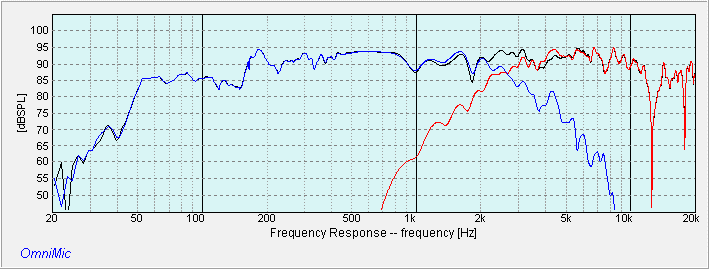 Fig 3 – Crossover Summation Fig 3 – Crossover Summation
The Black plot in Fig 3 shows the summation in the crossover. No cancellations are observed on either side of the crossover point, indicating good summing.
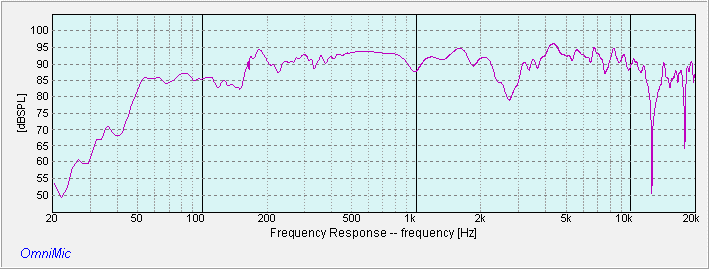 Fig 4 – Null Fig 4 – Null
Fig 4 is the Null with the tip at 2.7kHz. This is close to my targeted 2.5kHz. I can accept this crossover point as long as the vocal clarity is not compromised.
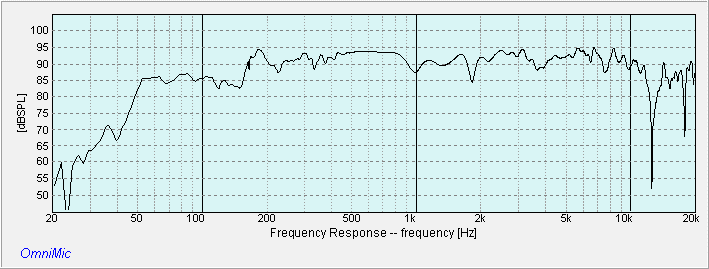 Fig 5 – Shikra Frequency Response Fig 5 – Shikra Frequency Response
The final Frequency Response of the Shikra is in Fig 5. She is remarkably flat (+/- 3dB) saved for a light notch at about 1.8kHz. That is from the MB820. There’s nothing I can do about it.
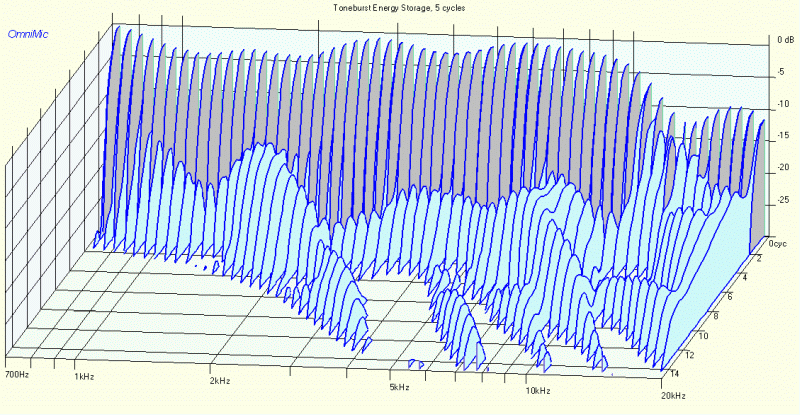 Fig 6 – Shikra Toneburst Energy Storage Fig 6 – Shikra Toneburst Energy Storage
The Toneburst plot (Fig 6) shows some stored energy (light blue slices) in the treble. I wouldn’t worry too much about this as the z-axis is in cycles. It is those from 1kHz~2kHz that needs my attention.
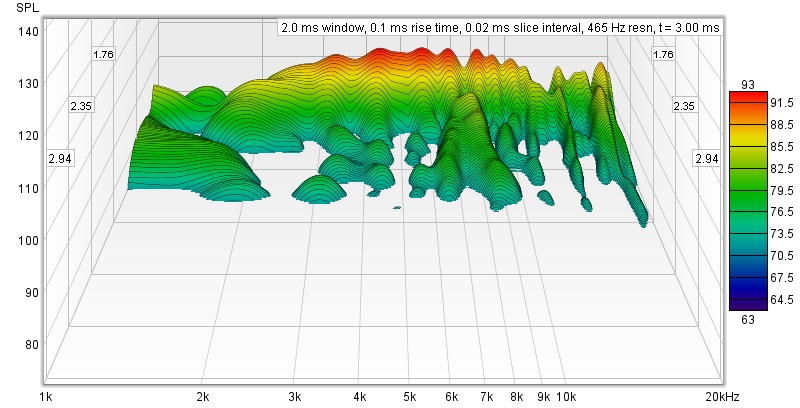 Fig 7 – Shikra Waterfall Fig 7 – Shikra Waterfall
We can see the artifacts clearer in the Waterfall plot. They are about 3.5kHz and one octave up at 7kHz.
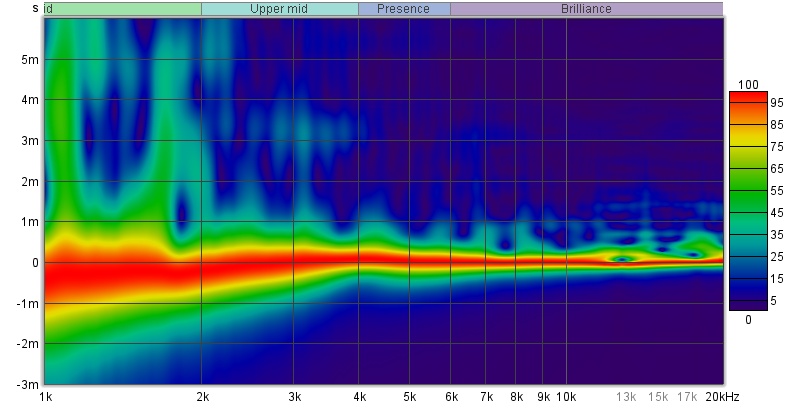 Fig 8 – Shikra Spectrogram Fig 8 – Shikra Spectrogram
The “ringing” in the horn from 2kHz~20kHz is not an issue because they don’t last more than 2msec. However, between 1kHz~2kHz, there are two distinct green streaks, one at about 1.1kHz and the other at 1.7kHz. Fortunately, they dissipate by 6msec. My guess is they are from the cone breakup of the MB820.
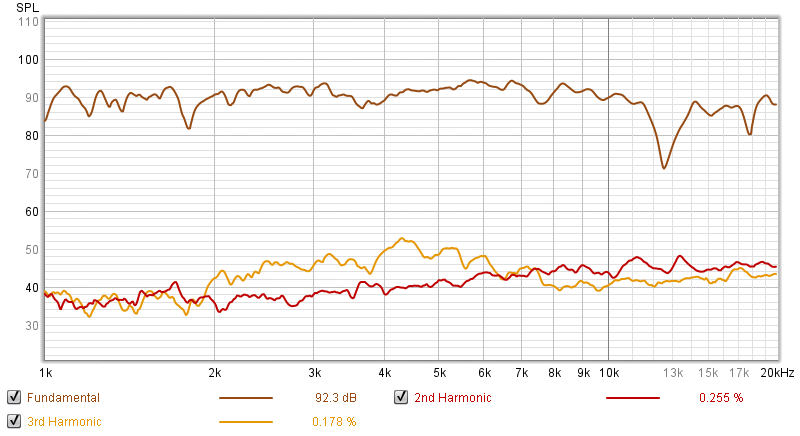 Fig 9 – Shikra Harmonic Distortion Fig 9 – Shikra Harmonic Distortion
The Harmonic Distortion is in Fig 9. The 2nd harmonic is at 0.255% and the 3rd at 0.178%. During auditioning, these distortion did not irritate my ears.
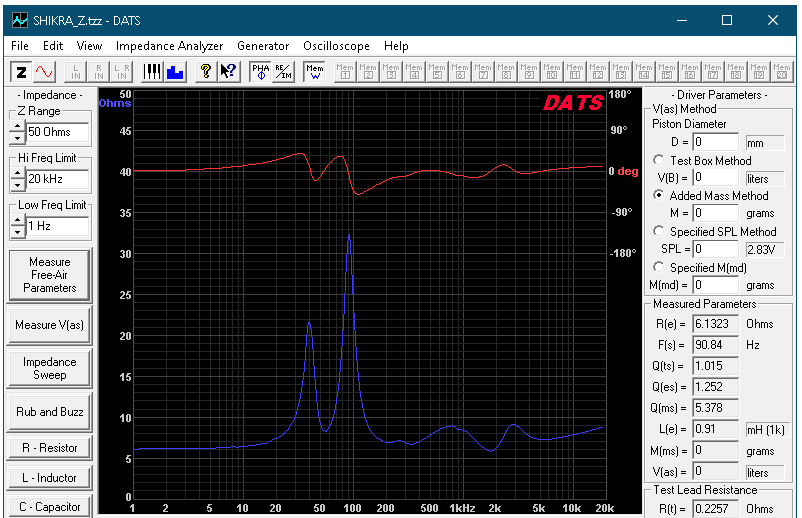 Fig 10 – Shikra Impedance Fig 10 – Shikra Impedance
The Shikra nominal impedance is 8Ω (Fig 10). Power amplifiers will be able to drive her easily. Her bass reflex port tuning is at 55Hz, exactly where my box simulation is.
In her treble, the impedance doesn’t fluctuate much. This is due to the flat impedance of the RX14. Because of that, her phase is +/- 5° from 300Hz~20kHz.
Shikra Sound
I was stunned by the performance of the Shikra. She’s not supposed to sound this good. This is a cheap horn with a budget PA woofer. What is out of place is a significantly more expensive compression driver, the Peavey RX14. That can’t be helped because there are no alternatives.
Back to the sound, the Shikra midrange is absolutely beautiful. Not shouty at all. Sibilance is well controlled. No “ssshhh”. Just natural.
As for the treble, I didn’t pick up any harshness at all. Moreover, there’s no brightness that’s normally associated with titanium diaphragms which the RX14 has.
Having listened to the Shikra for a few days, she’s definitely good enough for HiFi. Her strength is in her midrange and treble. She will excel as Main speakers in Home Theater. Her high sensitivity of 94dB (1W 1m) will endear herself to tube amplifier lovers. For HiFi where full bandwidth is desired, a subwoofer will be needed for the bass.
In the PA market, the Shikra is ideal for “Live” voice reinforcement. Her compact size will be advantageous in the field. For music reproduction in events, she can be used as a satellite mounted on top of a subwoofer with a pole. With her crossover at 2.7kHz, the RX14 power handling is enhanced, thus contributing to greater robustness.
For very little money, the Shikra offers superb performance. The Selenium HC23-25 is $17.99, the Dayton MB820-8 at $35.98 and the Peavey RX14 cost $69.99 (Parts Express). For approximately $125.00 in drivers per speaker, she is very affordable.
Highly recommended.
Unless otherwise stated, all measurements were made in Full Space (4pi). Mic at 36 ins, tweeter axis. Impulse Window=5ms. No smoothing applied. |
