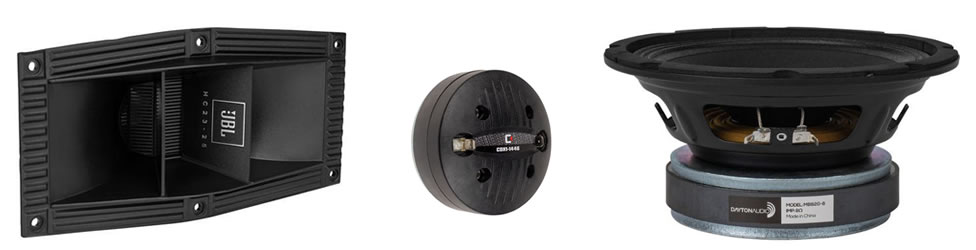
Shikra-CDX
Dayton MB820-8 with Celestion CDX1-1446/Selenium HC23-25
Having tested out the Selenium HC23-25 with a Peavey RX14, I’m curious as to whether the Celestion CDX1-1446 will match this horn. This compression driver is a slightly cheaper alternative to the RX14, so if it works, there’s some savings though not by much.
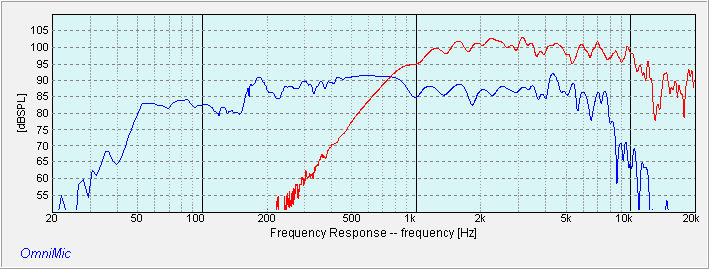 Fig 1 – Dayton MB820-8 Low Pass • CDX1-1446/HC2325 High Pass RAW Frequency Responses Fig 1 – Dayton MB820-8 Low Pass • CDX1-1446/HC2325 High Pass RAW Frequency Responses
Fig 1 is the relative loudness of the CDX1-1446/HC23-25 combo and the MB820-8. No crossovers are used. Microphone is at horn axis.
I was surprised to find the CDX1-1446 having the same response as the Peavey RX14. What this means is I probably will be able to use the same crossover as in the Shikra.
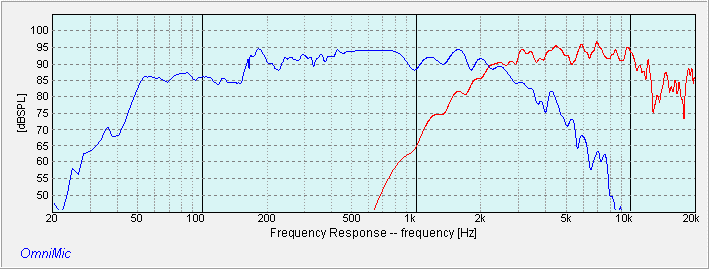 Fig 2 – MB820-8 Low Pass • HC23-25/CDX1-1446 High Pass Fig 2 – MB820-8 Low Pass • HC23-25/CDX1-1446 High Pass
Fig 2 shows the responses of the woofer (Blue plot) and the combo (Red plot) with the Shikra crossover.
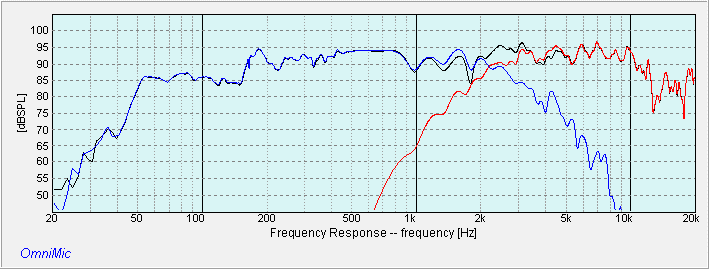 Fig 3 – Crossover Summation Fig 3 – Crossover Summation
This is where there are slight differences (Fig 3). The summing with the CDX1-1446 is not as “tight” as using the RX14 but it’s perfectly fine in use.
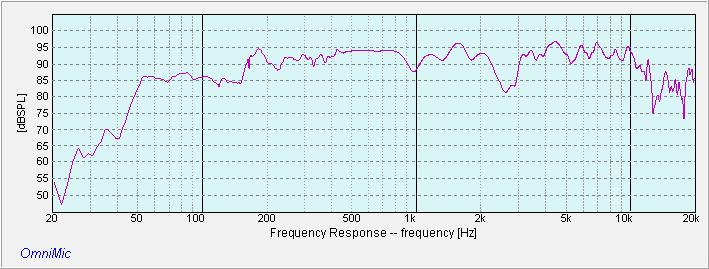 Fig 4 – Null Fig 4 – Null
Fig 4 is the Null with the tip at 2.7kHz. This is close to my targeted 2.5kHz. The notch is not as defined as the Shikra but again, it’s academic. The two drivers are still crossing properly.
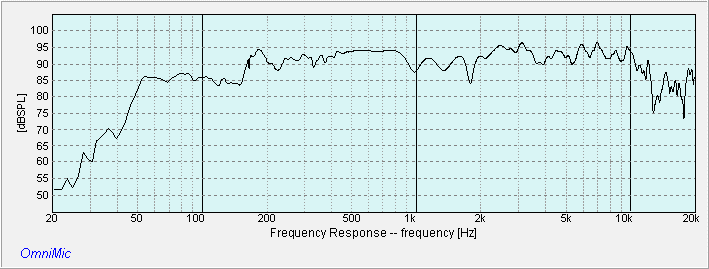 Fig 5 – Shikra-CDX Frequency Response Fig 5 – Shikra-CDX Frequency Response
The final Frequency Response of the Shikra-CDX is in Fig 5. There is a slight emphasis in the upper midrange from 2.5kHz~3kHz which I do not find objectionable. I will not bore readers with the other plots are they are more or less the same.
Shikra-CDX Sound
There’s not much of a difference between the Peavey RX14 and the Celestion CDX1-1446. Even for myself, I couldn’t tell them apart unless in an AB test. What it boils down to is price.
Mounting the CDX1-1446
Users should be aware that I had difficulty screwing in this CDX1-1446. It was tight towards the end. If you don’t lubricate the threads, there is a chance the horn and the compression driver will bind.
Unless otherwise stated, all measurements were made in Full Space (4pi). Mic at 36 ins, tweeter axis. Impulse Window=5ms. No smoothing applied. |