Shikra-PRV
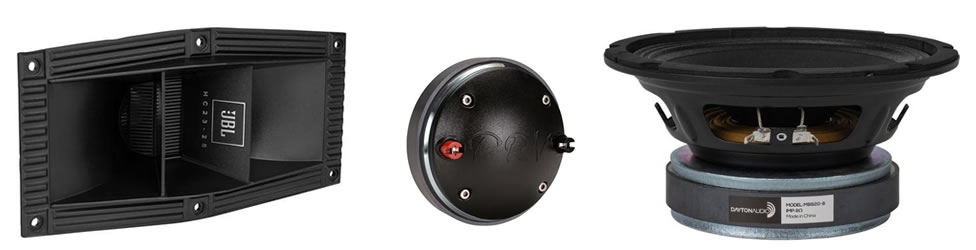
Dayton MB820-8 with PRV D280Ti /Selenium HC23-25
Something has been bothering me after testing the SeleniumHC23-25 with the Peavey RX14 and the Celestion CDX1-1446. It appears the response of the two compression drivers with the HC23-25 look similar. Over the years, not once have I encountered that before. Could it be the fins I accidently broke off in the HC23-25 contributed to this behavior.
To verify my hypothesis, I screwed on a PRV D280Ti. If the response looks the same, then the fins are the cause of the ragged response.
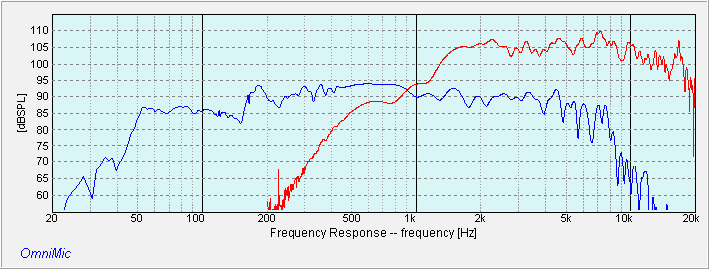 Fig 1 – Dayton MB820-8 Low Pass • D280Ti/HC2325 High Pass RAW Frequency Responses Fig 1 – Dayton MB820-8 Low Pass • D280Ti/HC2325 High Pass RAW Frequency Responses
Fig 1 is the relative loudness of the MB820-8 and the HC23-25 with the PRV D280Ti mounted. What do you know, I was right. The response of the HC23-25 is similar for all three compression drivers.
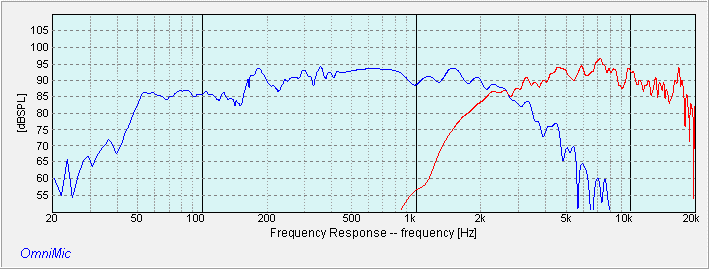 Fig 2 – MB820-8 Low Pass • D280Ti/HC23-25 High Pass Fig 2 – MB820-8 Low Pass • D280Ti/HC23-25 High Pass
For this exercise, I’m using the same crossover as in the original Shikra. The only change is the attenuation in L-pad.
Fig 2 shows the responses of the woofer (Blue plot) and the combo (Red plot) with their respective crossovers.
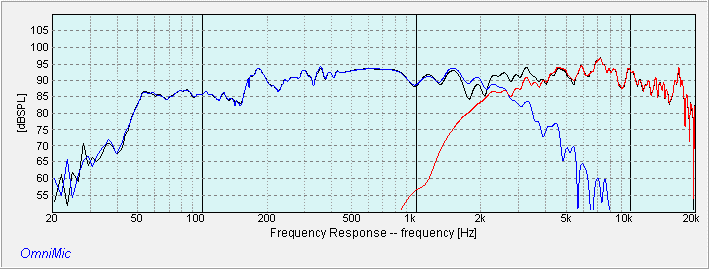 Fig 3 – Crossover Summation Fig 3 – Crossover Summation
The Black plot in Fig 3 shows the summation in the crossover. Some cancellations are observed on the left of the crossover point but in the crossover region, the summing is correct.
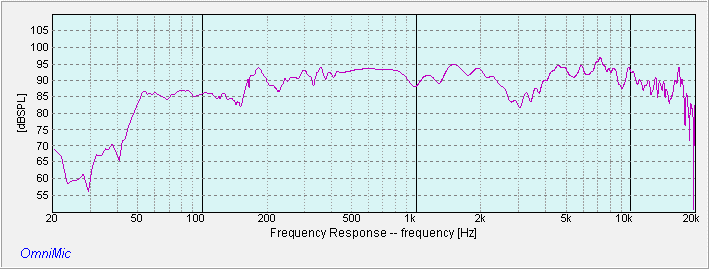 Fig 4 – Null Fig 4 – Null
Fig 4 is the Null with the tip at 3.0kHz. The shape of the notch indicates good roll-off in the two drivers.
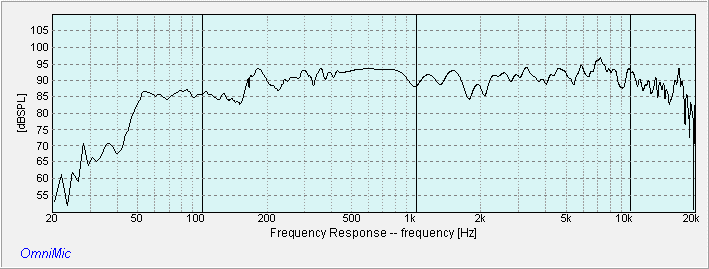 Fig 5 – Shikra-PRV Frequency Response Fig 5 – Shikra-PRV Frequency Response
The final Frequency Response of the Shikra-PRV is in Fig 5. She is flat (+/- 3dB) except for a dip at 2kHz. This is acceptable as I couldn’t pick this up during auditioning.
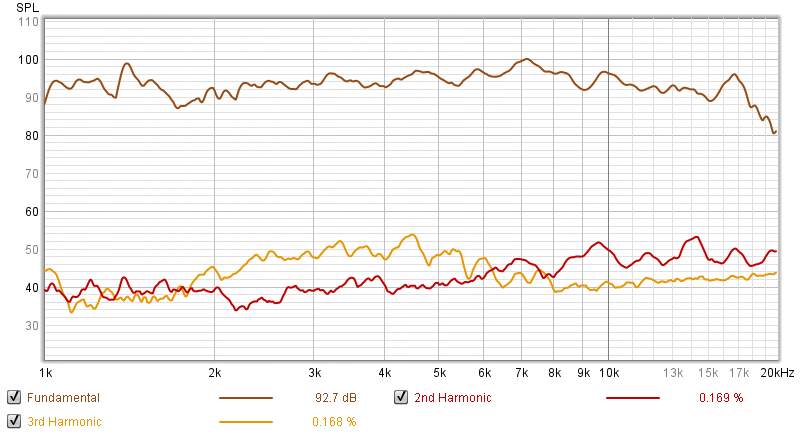 Fig 6 – Shikra-PRV Harmonic Distortion Fig 6 – Shikra-PRV Harmonic Distortion
The Harmonic Distortion in Fig 6 is quite good. The 2nd harmonic is 0.169% and the 3rd at 0.168%. They are low enough as not to irritate my ears.
Shikra-PRV
I am glad I investigated this horn further. Apparently, the two fins in the HC23-25 were affecting the response. I have no idea what the horn designers were thinking. From the looks of it, it seems they were trying to design a very crude sectoral horn. My advice is to simply break the fins off. They serve no purpose except to destroy what is an excellent exponential horn.
After tesing three compression drivers with this HC23-25 horn, I highly recommend the PRV D280Ti. Firstly, she is the cheapest at only $40.00. More than that, she sounds excellent. Even though she has a titanium diaphragm, she does not exhibit any harness nor brightness in the treble. Best of all, she screws in easily to the HC23-25. I can’t ask for more.
Shikra-PRV for Music
For full bandwidth, I hooked up my Toucan-SF. Even though she is a bandpass, I ran her through a 24dB/oct electronic crossover with the frequency set at 120Hz. This is necessary to prevent the bandpass from contaminating the midrange.
With the bass restored, the music is now complete. She Works Hard for the Money (Donna Summer) sounds fantastic. There’s so much detail in the bass that otherwise is loss without the Toucan-SF.
In Santana Corazon, the attack and timing of the bass in Saideira (Spanish version) is clearly heard.
On a final note, the Peavey RX14, Celestion CDX1-1446 and the PRV D280Ti can all be used with the Selenium HC23-25. The passive crossover is the same. The only change is the resistors in the L-pad to match the output of the compression driver to the woofer.
Unless otherwise stated, all measurements were made in Full Space (4pi). Mic at 36 ins, tweeter axis. Impulse Window=5ms. No smoothing applied. |