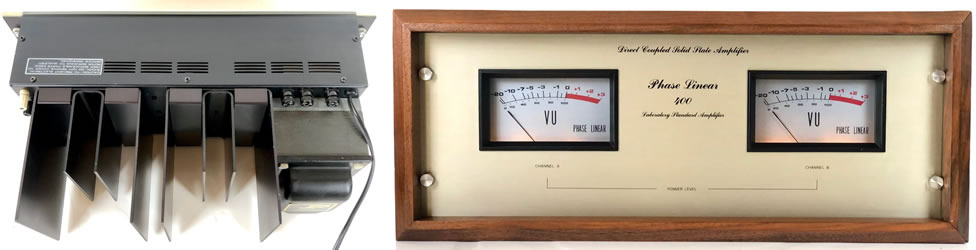
Phase Linear 400
Phase Linear 400 Power Amplifier Fig 1 is the schematic of the Phase Linear 400. For easier understanding, I traced the signal flow (Red line) from input to output. Most notable from this circuit is the use of only NPN transistors for the output power stage. This arrangement is known as Quasi-complementary. Quasi meaning it’s not really full complementary (NPN + PNP) but behaves like one. Nowadays, you won’t see many amplifiers with Quasi outputs because NPN transistors are readily available. If I remember correctly, the early Peavey CS800 (circa 1976) is also Quasi outputs. Starting at the input, the signal is fed to Q1 of the input differential. Instead of tapping the signal from the collector of Q1, it is Q2 that feeds the next stage Q4. The signal from the collector of Q4 drives the base of Q5 which is part of the VAS. Now the signal is primed to drive a Quasi-complementary output. In the upper half, Q10 is the pre-driver while Q11 is the main driver that drives all the power transistors. In the lower half, Q7 and Q12 act as level shifters. Only with this level shifters can the bottom NPN outputs be driven. Instead of using a transistor in the VAS for amplification, the Phase Linear 400 uses the bootstrap method. The output of the driver Q11 drives the VAS via a 47uF/40V capacitor. It serves the same purpose as using a transistor although this method fell out of favor in modern amplifiers. Summary The Phase Linear 400 design is very dated by today’s standard. The designer didn’t have much of a choice because in 1973, complementary power transistors were not available. To be fair, being able to deliver this kind of power in the early 70s is quite an achievement. Nonetheless, I’m inclined to adopt a modern circuit. So it won’t be a restoration project but a completely new amplifier. The only things I will re-use is the chassis, heatsinks and the power transformer. When I’m finished with this Phase Linear 400, she will “fly”. |
July 25, 2025Amplifiers, Electronics
