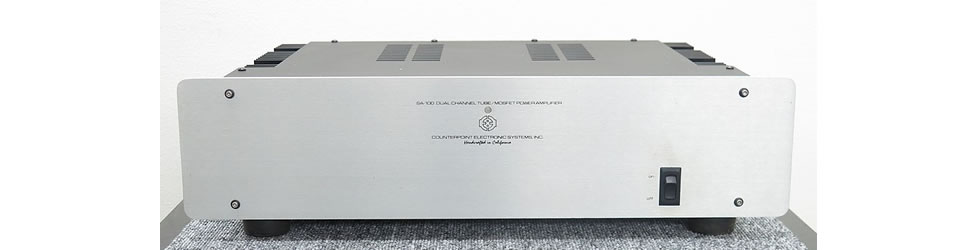
Counterpoint SA-100
Power output is 100W into 8Ω. Year of manufacture is 1989. Fig 1 below shows the Voltage Gain Stage with amplification provided by two 6DJ8 tubes. Counterpoint SA-100 Voltage Stage The input tube (V1b) has an anode resistor of 100KΩ with 1mA current running through the tube. The amplified signal (Red line) is then injected into the Grid of the second tube (V1a) for more amplification. The last stage (V2a) has no amplification. Her purpose is to drive the Current Stage power mosfets. Counterpoint SA-100 Current Stage
Fig 2 is the Current Stage section. The output of V2 goes through two 1uF/250V capacitors directly to the bases of the power mosfets.Gate resistors for the top N-channel 10N12 are 422Ω while the bottom P-channel ones are at 165Ω. Supply rails for this current section is at +-53Vdc which is much lower than the 300~325Vdc used for the vacuum tubes. There is a DPDT relay just before the gate resistors. It’s purpose is to switch off the power mosfets on power up. After a delay of a few seconds, when the preceding tubes in the Voltage Stage is stabilized, it connects the vacuum tubes output to the power mosfets. There is no Global Negative Feedback in the SA-100. NFB is only for the Voltage Stage. It’s from Cathode of V2a to the Cathode of V1b. Because of this, the power mosfets must be tightly matched to reduced distortion. It is encouraging to see that the designer did not depend solely depend on the ON-Resistance of the power mosfets for current sharing. External Source Resistors of 0.22Ω are incorporated instead. This should go a long way in the reliability of the amplifier. Summary I have always been fascinated by hybrid amplifiers like this Counterpoint SA-100. When I fully recover from my heart surgery, I will embark on the SA-100. Based on the circuit alone, the amplifier looks fine. Stereophile didn’t give them a very good review in 1991 which is intriguing. Looking at the schematic again. I would replace the Cathode Follower V2 with a ECC82. Further down the line, the elderly TO-3 power mosfets need to be replaced with newer IRFP240/9240. I would also like to examine using the lateral mosfets 2SK1058/2SJ162 instead of Vertical ones. I think that will go a long way in achieving the sound that I’m after. Lastly, I’ll check on stability without a Zobel network at the output. |
August 18, 2025Amplifiers, Electronics

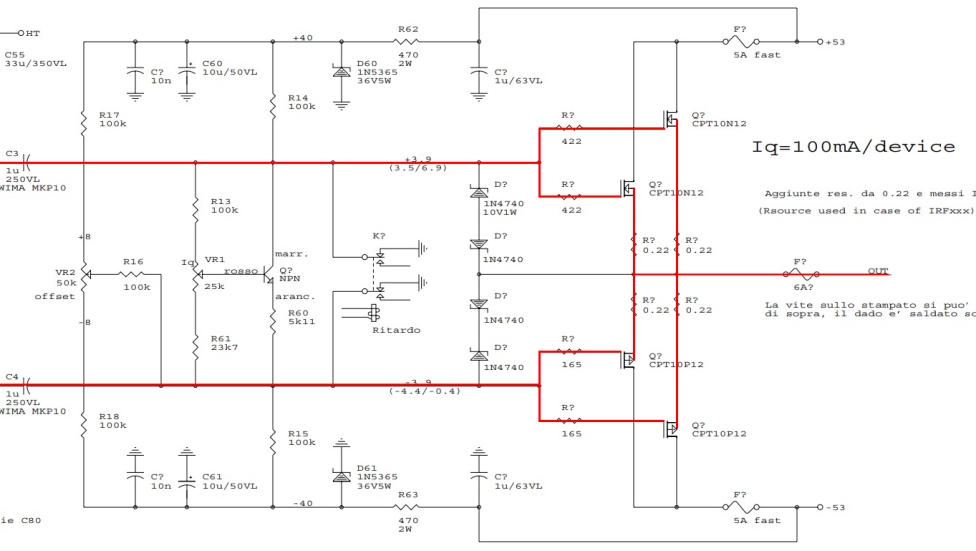 Fig 2 – Counterpoint SA-100 Current Stage