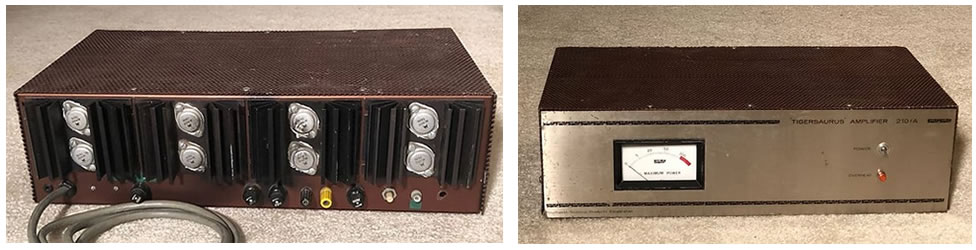
Tigersaurus 250
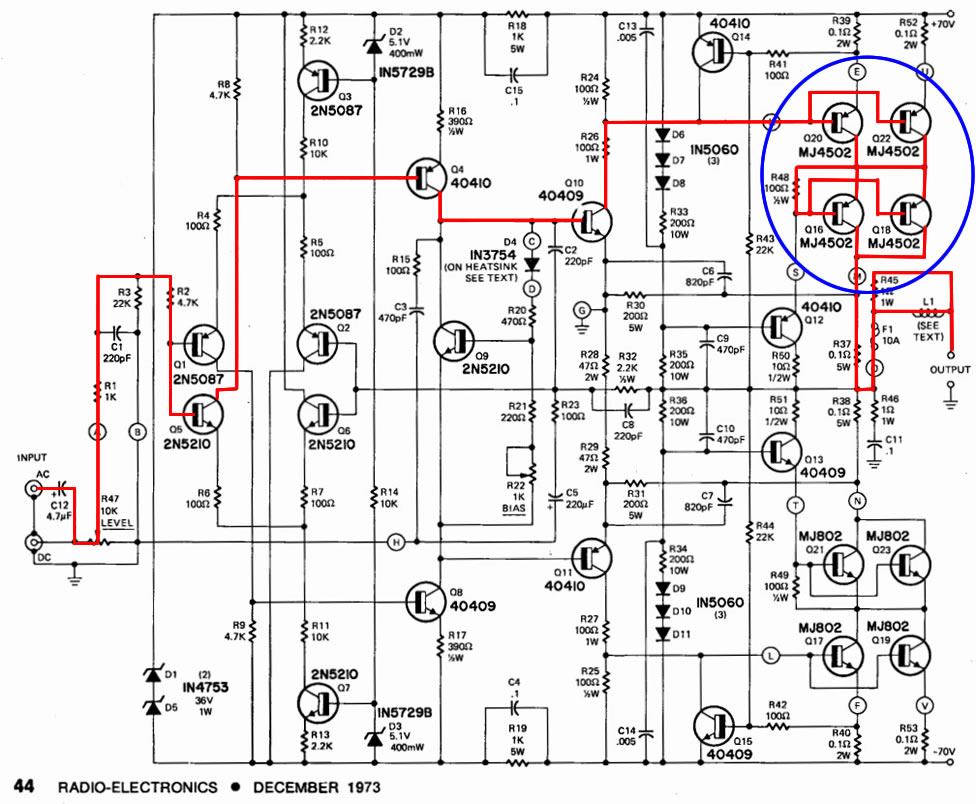
Tigersaurus 250 In1973, this is quite a bold attempt in amplifier design to adopt a mirror image typology (Fig 1). In such a typology, the top half and the bottom half are mirror image of each other.Typology like this has advantages but at the same time brings their own difficulties. Starting at the input, differential standing current is determined by a Constant Current Source. The collector load is 4.7kΩ (see Red line). The signal (Red line) is then connected to the VAS transistor (Q4) which is a 40410. This is where the voltage amplification stops. After this is the Current Stage. High voltage power transistors were not available in 1973. The best were the MJ4502 and the complementary MJ802. To get them to work at 70V, the designer resorted to stacking one on top of another. Therefore, each transistor is effectively seeing 35V, not 70V. This arrangement is known as a “Totem Pole” configuration (Blue circle). Summary The instability of the Tigersaurus is not attributed to her “Totem Pole” output only. I believe the lack of Miller compensation plays a huge part. To bring the Tigersaurus to the 21 century is possible but there need to be major revisions. |
August 19, 2025Amplifiers, Electronics