Rane MA6 Multichannel Amplifier
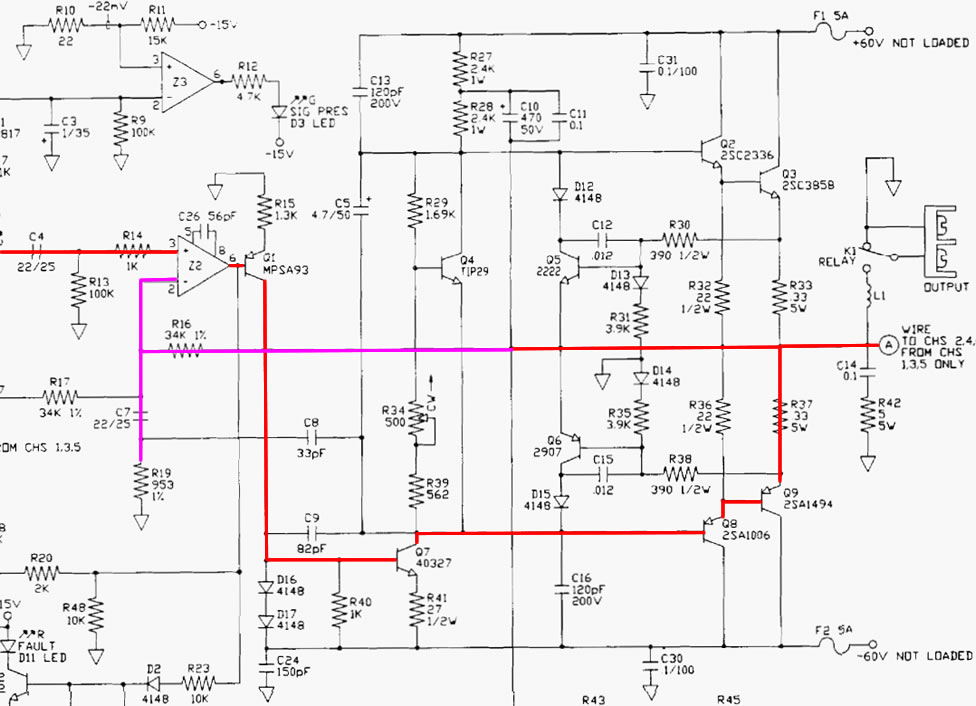
Fig 1 is the circuit of the MA6. At first glance, she looks very similar to the Peavey CS800 of 1976. The outputs are in Full-complementary instead of the CS800 Quasi. Apart from that, the typology is the same. The front end is an op-amp which drives a transistor at her output (Red line). This transistor has a 1kΩ resistor at her collector. This can be construed as one-half of an input differential. The amplified signal is fed to the next stage, the VAS. In this stage, two 2.4kΩ resistors at the top determine the standing current. Together with a 470uF capacitor, they form what is known as a bootstrap constant current source. The VAS output is fed to a Driver which in turn powers the output transistor.
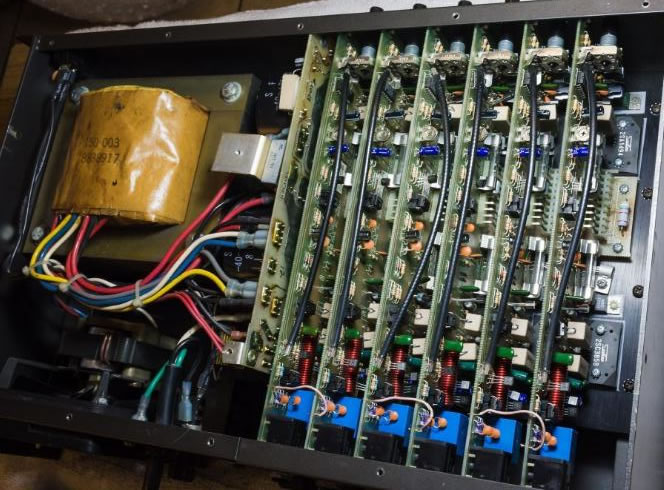
Fig 2 shows the six power modules inside the chassis. There is one large heatsink at the bottom that all the power transistors from the six channels are mounted to. In the module at the right, the Sanken MT-200 2SC3858 and 2SA1494 are clearly visible. For cooling, there’s a fan that’s located at the rear of the chassis Summary Even though the Rane MA6 started out as a multichannel amplifier for the commercial market, she is ideally suited for Home Theater use. 100W into 8Ω is plenty power for domestic applications. The only weakness I can see is there’s only two pieces of 10,000uF/80V filter capacitors in the PSU serving all six channels. Ideally, I would prefer 20,000uF per channel. That would mean a total of 120,000uF. That’s impractical for a commercial product as cost being a major factor. Furthermore, buyers will not appreciate the value of more capacitors. Nonetheless, it doesn’t distract from the fact that the MA6 is a very well made amplifier and is good value for money. |

September 22, 2025Amplifiers, Electronics