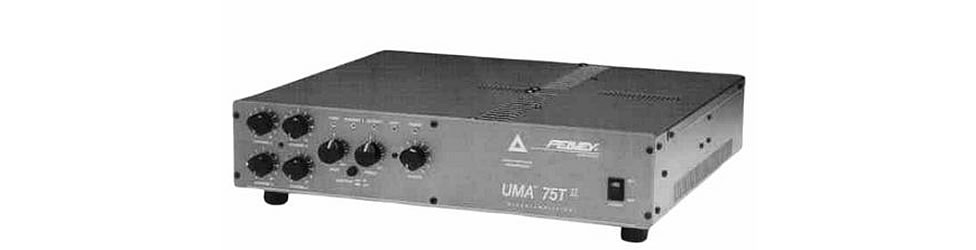
Spice – Peavey UMA 75
The power amplifier in the UMA 75 shares similar typology as those of the early QSC amps in that the power transistor outputs are grounded. The speaker is connected to the center of the two filter capacitors instead. For such a design to work, the input op-amp supply must be taken from the power amplifier’s otherwise the output will not swing to the rails. The basic schematic of the UMA 75 is in Fig 1. This circuit is used by Peavey in many of their amps, even to the high powered ones like the PV1200 model. To prevent thermal runaway, two of the diodes at the op-amp output are mounted onto the heatsink. The output bias is by a resistor in that diode string. Peavey’s schematic of the UMA 75 can be downloaded here.
Fig 2 is the Transient analysis of the Peavey UMA 75. It appears that the UMA 75 and the UMA 150 share the same circuit, except that the 150 uses more power transistors. Summary One should note that such circuits are not adopted by manufacturers of HiFi amplifiers. There must be advantages for them to be used in PA otherwise they won’t be so common. I have yet to prototype such a circuit to examine their technical strengths and weaknesses and their sound quality. Another one on my “To Do” list. |
October 13, 2025Amplifiers, Electronics

