Kestrel
Celestion CDX1-1747 / LaVoce HD1004 with Eminence Beta 8A
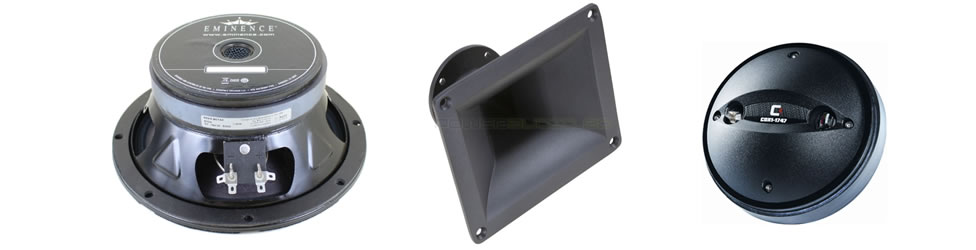
The Kestrel is based on a Celestion CDX1-1747 compression driver mated with a Lavoce HD1004 90°x60° metal horn. In this version the woofer I’m using is a Eminence Beta 8A, an 8″ pro woofer with a rated power handling of 225W RMS.
Since working with horns is the most difficult part of the design, I’ll address them here first.
 Fig 1 – Celestion CDX1-1747 with LaVoce HD1004 Frequency Responses Fig 1 – Celestion CDX1-1747 with LaVoce HD1004 Frequency Responses
The Blue plot in Fig 1 is the RAW response of the combo (no crossover). The Red plot with a high pass filter. My crossover frequency is targeted at 2kHz. This should be very comfortable for the CDX1-1747 as she’s rated for 1,600Hz. When I test her out with larger woofers, 12″ in particular, I’ll probably lower the crossover to 1,600Hz.
 Fig 2 – Eminence Beta 8A Frequency Response Fig 2 – Eminence Beta 8A Frequency Response
The Black plot in Fig 2 is the RAW response of the Beta 8A in a 24 liters bass reflex. The Blue plot is with a Low Pass installed.
 Fig 3 – Crossover Summation Fig 3 – Crossover Summation
In Fig 3, the horn combo and the woofer are crossing at 2kHz as predicted. The Black plot shows the summation at the crossover region. No cancellations are observed except for a slight dip at about 3.2kHz. That can be resolved by installing a notch filer at the woofer but it’s not worth the extra cost. Nobody will hear the improvement.
 Fig 4 – Kestrel Frequency Response Fig 4 – Kestrel Frequency Response
Fig 4 is the final frequency response of the Kestrel. She is virtually flat from 1.5kHz to 13kHz. Absolutely no peaks along the way. A response like this can qualify the Kestrel for HiFi.
 Fig 5 – Kestrel Null Response Fig 5 – Kestrel Null Response
When I re-wired the CDX1-1747 in-phase, it resulted in a beautiful deep notch at 2kHz. No active or passive delays are used. I managed to “time-align” the two drivers simply because the LaVoce horn is only 4″ deep.
 Fig 6 – Kestrel Waterfall Fig 6 – Kestrel Waterfall
The Waterfall plot (Fig 6) doesn’t record any anomalies. Bear in mind that the z-axis is at 2msec, so it is a highly magnified view. Some artifacts are seen but they are inaudible.
 Fig 7 – Kestrel Toneburst Energy Storage Fig 7 – Kestrel Toneburst Energy Storage
Fig 7 is another 3D representation of the response. This time, the z-axis is in cycles. The artifacts are the light blue slices. The horn combo is actually “cleaner”. The additional slices comes from the Eminence Beta 8A.
 Fig 8 – Kestrel Spectrogram Fig 8 – Kestrel Spectrogram
To put it in perspective, the Spectrogram (Fig 8) shows the artifacts in 2D. With this plot, it’s easier to see the amplitude of the artifacts. Notice all of them from 2kHz onwards are below 2 msec. I expect a good treble in the Kestrel.
 Fig 9 – Kestrel Step Fig 9 – Kestrel Step
The Kestrel Step (Fig 9) shows the acoustic centers of the two drivers are very close. This is an indication of good alignment.
 Fig 10 – Kestrel Distortion Fig 10 – Kestrel Distortion
The Distortion is quite low (Fig 10). The 2nd harmonic (Red plot) is -54.7dB below the fundamental while the 3rd (Orange plot) is marginally lower at -55dB.
 Fig 11 – Kestrel Impedance Fig 11 – Kestrel Impedance
The Kestrel is an easy load for amplifiers. Her lowest is 7Ω at 250Hz. From then on, she rises to 14Ω at 1.6kHz before leveling off at 10Ω. Best of all, her electrical phase is mostly resistive. From 250Hz onwards, there’s hardly an deviation from 0 phase. There should be no issues running two Kestrel in parallel.
An idea just came to mind. Maybe I’ll work on a MTM Kestrel in future. It’ll be interesting to see the outcome.
Summary
I have been listening to this Kestrel for a week. She’s quite well balanced tonally. Her midrange is clear enough, treble is superb and there’s bass. So much so that the Kestrel can be used without a subwoofer. Great for events where mobility, weight and compactness are required.
Unless otherwise stated, all measurements were made in Full Space (4pi). Mic at 36 ins, tweeter axis. Impulse Window=5ms. No smoothing applied. |