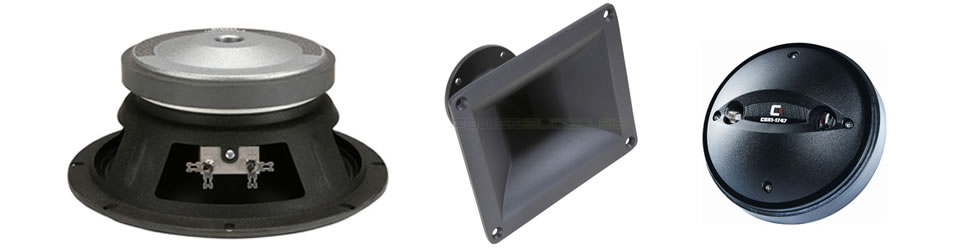
Kestrel-TF8
Celestion CDX1-1747 / LaVoce HD1004 with Celestion TF0818
In this 2nd version, the Eminence Beta 8A is replaced by a Celestion TF0818 8″ Midbass. The CDX1-1747 compression driver and the LaVoce HD1004 are retained. My purpose of using the Celestion TF0818 is to see whether this combination will result in a clearer vocal reproduction.
 Fig 1 – Celestion TF0818 – RAW (Black plot) • Low Pass (Blue plot) Fig 1 – Celestion TF0818 – RAW (Black plot) • Low Pass (Blue plot)
The Black plot in Fig 1 is the RAW response of the Celestion TF0818. The Blue plot is with a Low Pass filter with a targeted crossover frequency of 2kHz.
 Fig 2 – Celestion TF0818 Low Pass • CDX1-1747 with HD1004 High Pass Fig 2 – Celestion TF0818 Low Pass • CDX1-1747 with HD1004 High Pass
The Red plot in Fig 2 is the CDX1-1747 with the LaVoce HD1004 horn with a high Pass filter. Acoustically, they are crossing at about 1.9kHz.
 Fig 3 – Crossover Summation Fig 3 – Crossover Summation
The Black plot in Fig 3 is the summation of the High Pass and Low Pass. No cancellations are observed in the crossover region, indicating a proper crossover filters.
 Fig 4 – Kestrel-TF8 Frequency Response Fig 4 – Kestrel-TF8 Frequency Response
Fig 4 is the final frequency response of the Kestrel-TF8. She has a beautiful, flat response from 500Hz to about 13kHz.
 Fig 5 – Kestrel-TF8 Null Response Fig 5 – Kestrel-TF8 Null Response
Fig 5 is the Null response when the tweeter wires are in-phase. The notch centers at 1.9kHz, close enough to the 2kHz that is the original target. The notch is symmetrical indicating that the roll-off slopes in the midbass and compression driver are similar.
 Fig 6 – Kestrel-TF8 Waterfall Fig 6 – Kestrel-TF8 Waterfall
The Waterfall plot (Fig 6) does not record any audible artifacts.
 Fig 7 – Kestrel-TF8 Toneburst Energy Storage Fig 7 – Kestrel-TF8 Toneburst Energy Storage
Fig 7 is the Toneburst Energy Storage plot. The artifacts are the light blue slices.
 Fig 8 – Kestrel-TF8 Spectrogram Fig 8 – Kestrel-TF8 Spectrogram
The Spectrogram (Fig 8) shows the artifacts in 2D. From 2kHz onwards, the artifacts are inaudible because they dissipate by 2msec. This indicates the treble will sound very “clean”.
 Fig 9 – Kestrel-TF8 Step Fig 9 – Kestrel-TF8 Step
The Kestrel-TF8 Step (Fig 9) shows the acoustic centers of the two drivers are very close. This is an indication of good time alignment.
 Fig 10 – Kestrel-TF8 Distortion Fig 10 – Kestrel-TF8 Distortion
The Kestrel-TF8 Distortion (Fig 10) is a couple of dB lower than the Kestrel. From 5kHz onwards, the 2nd harmonic dominates. However, the 3rd harmonic is stronger from 3kHz to 4.5kHz. This originates from the TF0818 Midbass. Fortunately, this odd harmonic is very low, so it won’t irritate the ears.
Summary
This Celestion TF0818 needs to be broken in. Initially, the vocals were disappointing but after a week, she finally sang. The voices projected out of the mix.
Female voices sound spectacular. Stop This World (Diana Krall – The Girl in the Other Room) is reproduced perfectly. The sibilance is well controlled and the depth in the treble is astonishing.
Similarly, Ghost In This House (Amanda McBroom – Midnight Matinee), her voice is bewitching. No shrieking caused by peaks in the response. The sibilance has the right touch without being glaring.
One of the tracks I use to evaluate vocal clarity is How Am I Supposed to Live Without You (Michael Bolton). Reason is because in the recording, his voice is often in the background. If I can make out his voice clearly, I know the midrange will have clarity with other songs. With the Kestral-TF0818, he sounds perfectly fine. Not lost in the mix.
Another track is I Don’t Want to Talk About It (Rod Stewart – Atlantic Crossing 1975). In this album, the instruments are in the foreground and his voice is behind. With the Kestrel-TF8, the vocal is clearly heard.
This famous song was by Danny Whitten, an exceptionally gifted guitarist and songwriter that died too early tragically. He wrote and sang it in 1971 just before his death in 1972. You can find him singing this song on YouTube. Unlike Rod Stewart’s version, the original is very heart wrenching.
Comparing this Celestion TF0818 to the Eminence Beta 8A is like night and day. I recommend the Kestrel-TF8 for listeners that cherish vocal clarity above all else. For those that demand more bass, I suggest adding a bass bin. An 8″ 2-way pro speaker is essentially a mid/high unit.
Unless otherwise stated, all measurements were made in Full Space (4pi). Mic at 36 ins, tweeter axis. Impulse Window=5ms. No smoothing applied. |