|
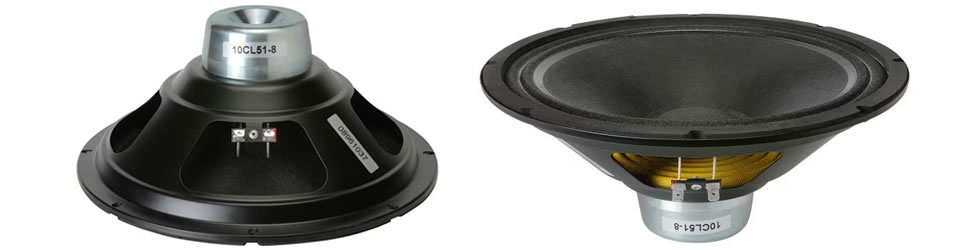
The plot above is from B&C. The response is impressively flat up to 3kHz where there’s a peak. After that, she dies off gracefully.
Fig 1 is my measurement of the B&C 10CL51 in a 35 liters ported box. I really love the flatness from 500Hz to 2kHz. With a response like this, the vocals will not be “shouty”. There is a small dip at about 2.2kHz which is inconsequential because I plan to crossover at 2kHz. Another point in her favor is her graceful roll-off. That will not create any null when I sum the CDX1-1747/HD1004 with the 10CL51.
Fig 2 is the Waterfall plot of the 10CL51. The main artifact is at 3kHz. It should not present any issues once I roll-off the woofer at 2kHz.
The Toneburst plot (Fig 3) presents the artifacts as Stored Energy (light blue slices). Note that the z-axis is now in cycles instead of msec as in the Waterfall. It may look like there’s a lot of artifacts above 2kHz but in reality, they are very minor.
When seen with a Spectrogram ( Fig 4), the artifacts from 2kHz upwards do not last more than 2msec. They will not degrade the treble unless we can hear at 2 msec. What is apparent is a bit of “hotness” at 1.5kHz. It’s not much so the vocals won’t end up “shouty”.
Similar to the previous woofers, the 3rd Harmonic is slightly stronger from 2.2kHz~7kHz (Fig 5). I wouldn’t worry too much because they are -52dB less than the fundamental. Moreover, they are “out of range” once I Low-Pass the woofer.
The Step response of the 10CL51 is quite good (Fig 6). The attack is fast and smooth. The apex is at about 50 microsec. Her decay is gradual with hardly any peaks. Summary I’ve been listening to this B&C 10CL51 for a few days and she sounds perfectly find. Her midrange is perfect so you won’t need to use EQ to tame any “shouty” voices. There’s also no “nasalness” male vocals. In the treble no brightness. That’s due to her smooth roll-off. On her own, the 10CL51 will make a fantastic speaker for vocal announcements. However, I would not recommend her for guitar cabs. For that, I would prefer a woofer with a more pronounced cone breakup. That will add some “zing” to the strings. Unless otherwise stated, all measurements were made in Full Space (4 pi) with the mic at 36 ins, tweeter axis. Impulse Window=5ms. No smoothing applied. |
December 9, 2025PRO DRIVERS


