|
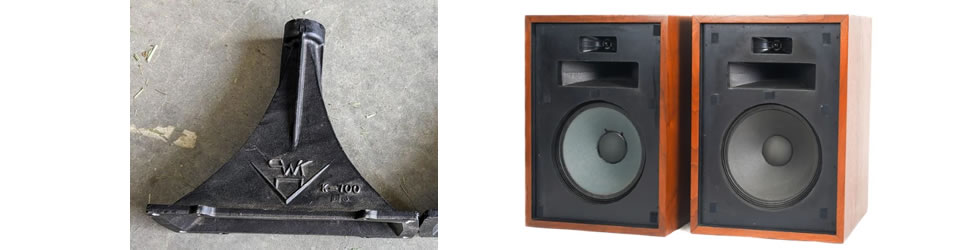
The K-700 is a midrange horn used in the first version of the Klipsch Heresy. It was a 3-way loudspeaker consisting of a 12″ woofer in a sealed box, the K-700 midrange horn and finally the K-77 horn tweeter. The Heresy 1 was manufactured way back in 1957. I personally have not owned nor heard this loudspeaker but judging from owner’s feedback online, it’s like a love/hate relationship. I have always been curious about this horn and her cult status but I was not prepared to fork out what sellers on eBay were asking. A few months ago, I finally committed on a pair in very good condition for $150 (less shipping). However, I didn’t want to pay $350/pair for the dedicated K-55 midrange compression drivers. They were just too much for something that’s almost 70 yrs old. When the horns arrived, I decided to mate it with my JBL2424H-C compression driver. That was when I discovered that the K-700’s throat is smaller than the standard 1″ that we are accustomed to. How badly this mismatch will affect the response is left to be seen. Klipsch K-700 with JBL 2424H-C
Fig 1 is the RAW response of the K-700 with the JBL2424H-C mounted. No crossover is used and the plot is not smoothed. Frankly, I was surprised with the result. She is quite flat from 2kHz~10kHz. I have no issues using the K-700 as a tweeter. After all, the majority of 1″ horns that I have tested starts to cut-off at about 2kHz anyway. If I want to use the K-700 down to 700Hz, I will have to find a midrange compression driver. The only one I have is a budget Pyle PDB512 which is discontinued. But I will need to use an adapter because she is a bolt mount version. Furthermore, with their throats mismatched, I shudder to think what will happen.
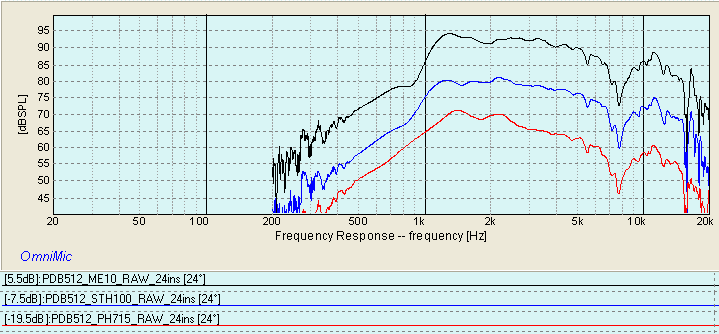
Just for reference, Fig 2 are the responses of the PDB512 with a few horns that I tested in 2018. Note the dip in the response. The best is with the STH100 (Blue plot). This is what the Klipsch K-700 with the K-55 Squawker will roughly look like. You can clearly see the upper end is about 6kHz, beyond which a super tweeter is needed.
The Waterfall plot in Fig 3 shows artifacts at 2K and smaller one at 8K. This is a microscopic view because the window is at 2msec.
Fig 4 is the ToneBurst plot. This is another representation of the Waterfall. The difference is the z-axis is now in cycles. The artifacts are the light blue slices. They may look a lot but when calculated in reference to time, the artifacts are nothing to worry about.
In the 2-D Spectrogram (Fig 5), we can see from 2kHz onwards, the artifacts do not last more than 2msec. In fact, from 3kHz ~ 20kHz, they are below 1msec. In all practical purposes, this is beyond human hearing.
The K-700 with the JBL 2414H-C exhibits very low 3rd harmonics in my operating region (Fig 6). Strangely, the 2nd harmonics is higher but I’m not worried about this. Had this been the other way around, that would be cause for concern.
Lastly, Fig 7 is the all important Impedance plot. What I’m after is where does the resonating frequency lie and what it looks like. I am heartened to see a single symmetrical peak centering at 2.5kHz. The bad part is it lies within my operating region. I will need to tame this peak in the crossover otherwise the treble will sound “shrill” when the music hits this frequency. Summary Having measured the Klipsch K-700 horn, I’m amazed that they were able to design a horn of this quality during that era. We are looking at a time when computers didn’t even exist. In other words, the engineers will need to know their stuff because every thing is calculated manually. Incredible. In the coming days, I will work on a crossover for this combo. I’m excited to hear how this vintage horn sounds like when mated with a modern compression driver. Stay tuned. Unless otherwise stated, all measurements were made in Full Space (4 pi) with the mic at 36 ins, tweeter axis. Impulse Window=5ms. No smoothing applied. |
February 18, 2026Drivers Evaluation, PRO DRIVERS