Bunting
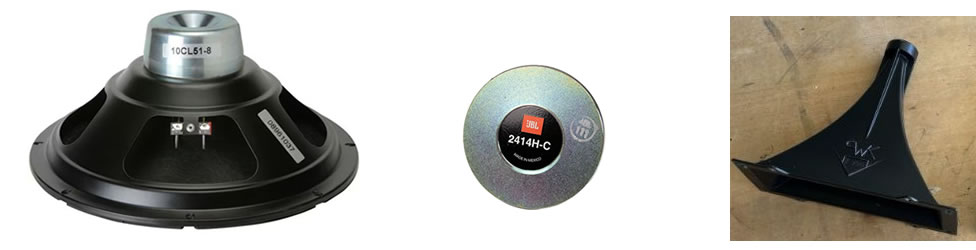
Klipsch K-700 +JBL 2414H-C with B&C 10CL51
The Bunting is based on a vintage Klipsch K-700 horn mated with a modern JBL 2414H-C. The woofer is a 10″ Neo B&C 10CL51 mounted onto a 35L bass reflex with a tuning port of 3″ in Diameter and a Length of 3″.
 Fig 1 – K-700 with JBL 2414H-C HP (Red plot) • B&C 10CL51 LP (Blue plot) Fig 1 – K-700 with JBL 2414H-C HP (Red plot) • B&C 10CL51 LP (Blue plot)
The Red plot in Fig 1 is the K-700/2414H-C with a High Pass network. The Blue plot is the B&C 10CL51 with her Low Pass. The crossover is symmetrical in that both drivers have a textbook 18dB/oct roll-off.
 Fig 2 – Bunting Frequency Response Fig 2 – Bunting Frequency Response
The Black plot in Fig 2 is the final frequency response. She is virtually flat from 500Hz ~ 9kHz with the exception of a light notch at about 2.5kHz. This is caused by the woofer buried beneath the K-700 in the roll-off.
I left the notch there because I doubt anyone can hear it. However, the notch can be removed. Just more components in the crossover, that’s all.
 Fig 3 – Null Response Fig 3 – Null Response
The Violet plot in Fig 3 is the Null response when the JBL2414H-C wires are flipped around. The Null is sharp and deep, with her tip at -35dB centering at 2kHz. This indicates good alignment of the K-700/JBL2414H-C combo and the woofer.
 Fig 4 – Bunting Waterfall Fig 4 – Bunting Waterfall
The Waterfall plot (Fig 4) is a highly magnified view of the treble artifacts. Note the time window is at 2msec.
 Fig 5 – Bunting ToneBurst Energy Storage Fig 5 – Bunting ToneBurst Energy Storage
Fig 5 is another representation of the Waterfall. The light blue slices are the stored energy (artifacts). The z-axis is now in cycles as opposed to time in the Waterfall. To the uninitiated, the number of light blue slices may seem plentiful but in reality, they are quite insignificant.
 Fig 6 – Bunting Spectrogram Fig 6 – Bunting Spectrogram
The Spectrogram (Fig 6) shows the artifacts in 2D. It is clear that the artifacts are dissipated after 2msec. In other words, they are inaudible.
 Fig 7 – Bunting Harmonic Distortion Fig 7 – Bunting Harmonic Distortion
The Bunting’s Distortion is quite low. It appears that from 1.5kHz~4kHz, the 3rd harmonic is slightly stronger than the 2nd whereas after 4kHz, the 2nd harmonic dominates.
How does the K-700 sound like?
In one word, wonderful. I never expected a horn that’s manufactured in 1957 can sound so good. We are talking about 70 years ago. The word computer didn’t even exist then.
There’s absolutely no harshness in the treble, no brittleness and she doesn’t spit at you. More than that, her horizontal dispersion is outstanding. I would say the K-700 is a very refined horn indeed, more HiFi sounding than PA horns.
Sound of Bunting
I really love this speaker. Her vocals are crystal clear. No veil whatsoever. One of the tracks I was listening to is “The Girl In The Other Room” by Diana Krall. Her voice projected out of the speaker with a clarity that’s scary. And that dreaded sibilance is sweet, not harsh like some horns.
For male voices, I had on a duet of Willie Nelson and Julio Iglesias “To All The Girls I’ve Loved Before”. The lyrics are a bit offensive for some women and I can understand why. Nonetheless, their vocal harmony is perfect.
As for realism, the Bunting is FAST. I played “Get Over It” by Eagles (Hell Freezes Over). The timing of the bass, midrange and highs are in step. This is something that’s very difficult to achieve in loudspeaker design.
the Heresy 1 Crossover
 Fig 8 – Heresy 1 Crossover Fig 8 – Heresy 1 Crossover
Fig 8 is the original crossover of the Heresy 1. It is a very basic crossover, 1st order throughout.
In the middle, the SQUAWKER is the K-700 with the K-55 midrange compression driver. It is a 1st order bandpass, a capacitor and an inductor. From this network, we can see they are using the K-700 horn cutoff as the High Pass because the 2uF is not a High Pass filter.
Bunting Crossover Fig 9 – BUNTING Crossover Fig 9 – BUNTING Crossover
Fig 9 is the Bunting’s crossover. It is more advanced than the Heresy 1. The complexity is necessary to get the response and musicality that I’m after.
It’s unfortunate that I don’t have the Klipsch K-55 Squawker to work with. It would be interesting to see how she performs with the K-700.
So there you have it, the Klipsch K-700 with a new lease of life.
Unless otherwise stated, all measurements were made in Full Space (4pi). Mic at 36 ins, tweeter axis. Impulse Window=5ms. No smoothing applied. |