Bunting II
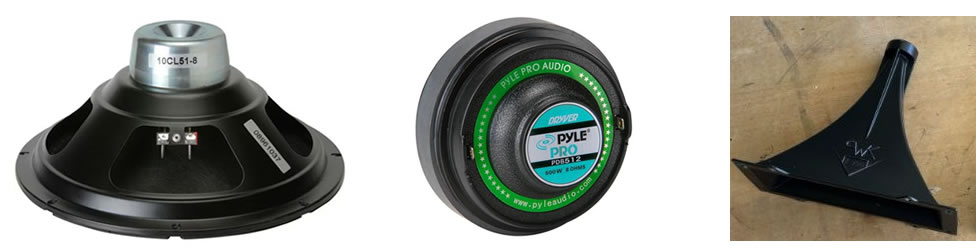
Klipsch K-700 + Pyle PDB512 with B&C 10CL51
I went through a few versions in designing the Bunting II. Though some measured better, this is the one I’m most satisfied with musically. Furthermore, it emulates the response of the Heresy 1 in that the crossover between the K-700 and the woofer is at 700Hz.
 Fig 1 – K-700 with PDB512 with HP (Red plot) | B&C 10CL51 woofer with LP (Blue plot) Fig 1 – K-700 with PDB512 with HP (Red plot) | B&C 10CL51 woofer with LP (Blue plot)
The Red plot in Fig 1 is the High Pass response of the Klipsch K-700 horn with the Pyle PDB512 mounted. The Blue plot is the 10″ Neo B&C 10CL51 woofer with her Low Pass filter. Acoustically, the two drivers are crossing at 700Hz.
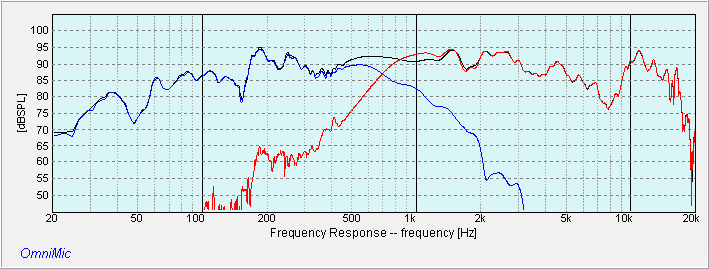 Fig 2 – Summation Region Fig 2 – Summation Region
The Black plot in Fig 2 shows the summation of the two drivers. It is very smooth except for a light cancellation at 1kHz. That actually helps otherwise the Bunting II may end up “shouty”.
 Fig 3 – Bunting II Frequency Response Fig 3 – Bunting II Frequency Response
Fig 3 is the Bunting II Frequency Response. We can see at 3kHz she tapers down to 8kHz (-12dB). At this point, she suffers from cone breakup resulting in a peak at 12kHz.
 Fig 4 – Bunting II Null Response Fig 4 – Bunting II Null Response
Fig 4 is the Null response when the PDB512 wires are flipped. The Null centers at about 660Hz, very close to the 700Hz acoustic crossing.
 Fig 5 – Bunting II Waterfall Fig 5 – Bunting II Waterfall
The Waterfall plot (Fig 5) shows a bunch of artifacts from 10kHz onwards.
 Fig 6 – Bunting II Toneburst Energy Storage Fig 6 – Bunting II Toneburst Energy Storage
The same burst of energy (light blue slices) is seen in the Toneburst plot.(Fig 6). I’m not alarmed by this because the z-axis is in cycles.
 Fig 7 – Bunting II Spectrogram Fig 7 – Bunting II Spectrogram
In the Spectrogram (Fig 7), we can see the artifacts from 2kHz onwards do not last more than 2 msec. Even the burst at 10kHz~20kHz is completely dissipated by then. We cannot hear at 2 msec, so there’s nothing to worry about.
What is more concerning are the green streaks from 1kHz~2kHz. Fortunately, they are -50dB by 4 msec. During auditioning, I didn’t detect any screaming in this region.
 Fig 8 – Bunting II Harmonic Distortion Fig 8 – Bunting II Harmonic Distortion
The Bunting II Harmonic Distortion (Fig 8) is quite impressive. From 1kHz~20kHz, the 2nd harmonic dominates.
 Fig 9 – Bunting II Step Fig 9 – Bunting II Step
The Step response is in Fig 9. It is not as smooth as can be but given the circumstances, it’s acceptable.
 Fig 10 – Bunting II Excess Phase Fig 10 – Bunting II Excess Phase
The Excess Phase is in Fig 9. There are two glitches between 900Hz and 1kHz. This indicates EQ is not recommended in this region.
Extending the Bandwidth – Selenium ST200
 Fig 11 – Bunting II Extended Bandwidth Fig 11 – Bunting II Extended Bandwidth
I listened to the Bunting II response in Fig 3 and found the music too “Dull” for my liking. The treble is hardly audible. While it is great for Voice announcements like in paging, it is not good enough for music. I eventually added a Selenium ST200 super tweeter (Fig 11) to the speaker. That made a world of difference. The treble is restored and it sparkles. With this addition, the Bunting II is exactly like the Heresy 1, a 3-way.
More Auditioning
I thought the Bunting II is ready but when I auditioned her further, I heard her resonant frequency flare up. I was shock it was so pronounced. That is the 1kHz peak shown in the Impedance plot. I installed a series LCR and it did the job, killed-off the resonance. One other thing that was bothering me was the crossover. I was never too happy with the 1st order that I used earlier. So I upgraded it to a 2nd order. The result is startling.
 Fig 12 – Bunting II FINAL NULL Fig 12 – Bunting II FINAL NULL
Fig 12 is the Null response with the K-700/PDB512 combo with a new 2nd order filter. Now, the shape and depth of the notch is beautiful, meaning the drivers are Time-Aligned..
 Fig 13 – Bunting II FINAL Frequency Response Fig 13 – Bunting II FINAL Frequency Response
Fig 13 is the final frequency response of the Bunting II. It looks very similar to Fig 11 but rest assured, the sound is superior. Measurements don’t tell everything. Only the ears can.
Bunting II Crossover Fig 14 – BUNTING II Crossover Fig 14 – BUNTING II Crossover
I tried to keep the Crossover as simple as possible but to get the sound I’m after, Fig 14 is what is needed.
Right at the top is the Selenium ST200 super tweeter. This is a simple 1st order, a capacitor and a resistor for padding the volume. In the middle is the K-700/PDB512 horn. At the front is a 2nd order high pass filter followed by an EQ network, then a series LCR to tame the resonant peak. Last is an L-pad to lower the volume to the 10CL51 woofer. Below the K-700 combo is the B&C 10CL51 Neo woofer. The netwrok is basically a 3rd order Low Pass network and a Zobel. I know the crossover looks intimidating but I can’t keep it simpler than this.
Is this complexity necessary? That depends on your ears. If you want the best sound out of the K-700, then yes, it is. If you don’t have the ear for it, use the original Heresy 1 crossover. It’s simpler and cheaper.
 Fig 15 – BUNTING II Impedance Fig 15 – BUNTING II Impedance
The Bunting II Impedance is in Fig 15. With a Re of 6.45Ω, this would normally be rated as a Nominal Impedance of 8Ω. However at 200Hz, the impedance drops to about 5Ω, so it’s best to drive her with an amplifier rated for 4Ω. If driven with a tube amplifier, it’s recommended to use the 4Ω tap in the output transformer.
What is outstanding is the electrical phase. From 200Hz~20kHz, she’s virtually flat. Because of this unique feature, there’s no danger of the power amplifier being stressed due to the phase displacement in the Bunting II.
Sound of Bunting II
This Bunting II is scary. Even I’m surprised by what I did. The details and depth in the vocals are something I’ve never hear before.
Since the Klipsch K-700 was introduced in the 50s, I started with music of that era. One of the tracks I played is “Only You” by The Platters (1955). The reproduction is amazing. Their vocals cut through the mix and are well defined.
Another track is “The Great Pretender” released the same year. It touches on the loneliness one encounters in a breakup. But it’s more than that. It’s also about how some people cope with it. This particular person erected a facade to mask the pain. So on the surface, he appears happy but beneath that veneer is pain.
These emotions are conveyed through their singing. It stirs the heart.
Now that I’m on this nostalgia path, I can’t help but play “Kiss and Say Goodbye” by Manhattans. This song was released in 1976 and hit number 1 in the US Billboard Hot 100. Every time I listen to this song, I shake my head. The guy and the person he’s having an affair with are both married. Wow, that a recipe for trouble. In the end, the man decided to walk away (Smart man). And that brings us to the beginning of the song.
Anyway, as far as the singing is concerned, the raw feelings are conveyed.
Summary
The Bunting II measurements are not as impressive as some of the horns I tested before but rest assured, she sounds fantastic.
It is unfortunate that the Pyle PDB512 is discontinued. Even though she’s not the best fit, the combo still sounds great. Crossing the K-700 at 700Hz means a super tweeter is required to fill the upper treble. That’s a small price to pay in resurrecting the K-700.
Because the Pyle PDB512 is no longer available, I’ve been searching around for another midrange compression driver. I finally chanced upon a Selenium D-250X. I ordered one and she will be arriving soon. If the results are good, at least there’s another compression driver for the K-700 horn.
Unless otherwise stated, all measurements were made in Full Space (4pi). Mic at 36 ins, tweeter axis. Impulse Window=5ms. No smoothing applied. |