Bunting III
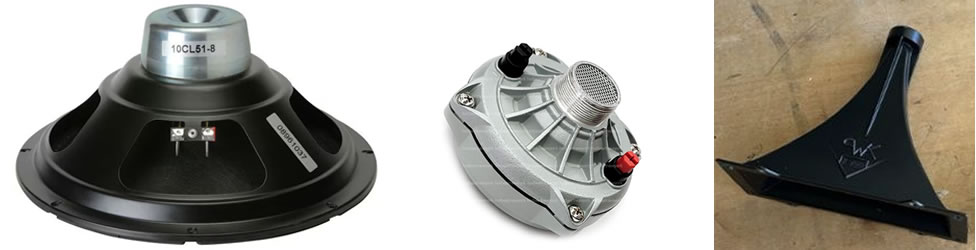
Klipsch K-700 + Selenium D250X with B&C 10CL51
Having mulled on this Selenium D250X overnight, I decided to keep things simple. The response of the D250X is what it is. There’s really nothing I can do with a poor response. I don’t know whether it’s the horn or the driver but my guess is the exit angle of the D250X and the Klipsch K-700 is a poor match. I’ve encountered this on numerous occasions when I tested various drivers with the horns I have. When they match well, the response is beautiful, like in the Dayton H812 with the Selenium D220Ti.
 Fig 1 – K-700 with D250X with HP (Red plot) | B&C 10CL51 woofer with LP (Blue plot) Fig 1 – K-700 with D250X with HP (Red plot) | B&C 10CL51 woofer with LP (Blue plot)
The Red plot in Fig 1 is the High Pass response of the Klipsch K-700 horn with the Selenium D250X. I managed to level the response from 1kHz~3.5kHz. Beyond that I cannot use because of that big chunk that’s bitten off. So effectively, I have 700Hz~3.5kHz working bandwidth. That’s not too bad. I still have about 2.5 octave.
The Blue plot is the 10″ Neo B&C 10CL51 woofer with her Low Pass filter. Acoustically, the two drivers are crossing at 700Hz.
 Fig 2 – Summation Region Fig 2 – Summation Region
The Black plot in Fig 2 shows the summation of the two drivers. It is very smooth except for a light cancellation at 1kHz.
 Fig 3 – Bunting III NULL Response Fig 3 – Bunting III NULL Response
Fig 3 is the Bunting III Null Response. The notch is at 700Hz which is my targeted frequency. She is not as deep as I would like but very close to being time aligned. The shape of the null is symmetrical, indicating the roll-offs in the two drivers are similar.
 Fig 4 – Bunting III Frequency Response Fig 4 – Bunting III Frequency Response
Fig 4 is the Summed response of the Bunting III. From this plot, the response is generally flat (+- 2.5dB) from 200Hz~3.5kHz.
 Fig 5 – Bunting III Waterfall Fig 5 – Bunting III Waterfall
In the Waterfall plot (Fig 5), the main artifact seems to be between 1kHz~2kHz.
 Fig 6 – Bunting III Toneburst Energy Storage Fig 6 – Bunting III Toneburst Energy Storage
The Toneburst plot (Fig 6) recorded excess energy (light blue slices) from 1kHz~2kHz.
 Fig 7 – Bunting III Spectrogram Fig 7 – Bunting III Spectrogram
In the Spectrogram (Fig 7), the peaks from 2kHz~20kHz are dissipated by 2 msec. In practical terms, these artifacts are inaudible.
 Fig 8 – Bunting III Harmonic Distortion Fig 8 – Bunting III Harmonic Distortion
The Bunting III Harmonic Distortion (Fig 8) is the worse I’ve ever encountered. The 3rd harmonic is massive at 1.5kHz and from 3kHz~10kHz. There’s nothing I can do to remedy this.
 Fig 9 – Bunting III Step Fig 9 – Bunting III Step
The Step response is in Fig 9. It appears the attack of the horn is rather slow.
 Fig 10 – Bunting III Excess Phase Fig 10 – Bunting III Excess Phase
The Excess Phase is quite good. (Fig 9). It is very clean all the way to 10kHz. This indicates EQ can be safely applied up to 10kHz if need be.
Extending the Bandwidth – Peerless H26TG45
 Fig 11 – Bunting III Extended Bandwidth Fig 11 – Bunting III Extended Bandwidth
To extend the bandwidth of the Bunting III, I decided to use a HiFi tweeter this time round, just for the fun of it. I added my horn loaded Peerless H26TG45 to the combo. Fig 11 above is the final response of the Bunting III. Now, she goes up to 10kHz, after which she rolls off gracefully. However, there’s a lot of interference hence the series of notches. During auditioning, I didn’t detect anything awful so the H26TG45 is usable.
Auditioning
Now that the bandwidth is restored, I proceeded with auditioning the Bunting III. It took five different versions before I finally settled on this crossover.
Bunting III Crossover Fig 12 – BUNTING III Crossover Fig 12 – BUNTING III Crossover
I tried to keep the components as few as possible. In the horn section, C2 is a 1st Order High Pass (Fig 12). This is different from the original Heresy 1 crossover where the 2uF used is not a High Pass filter. In fact, there’s no High Pass component. They used the horn cutoff as the High Pass. The trouble with that approach is bass is still entering the compression driver. It’s just not heard because the horn cuts off at 700Hz. At a certain loudness, the K-55 compression driver will sound shrill.
As for the woofer, I simplified it to a 2nd order. It is then followed by a Zobel. Lastly, there’s only a capacitor for the Peerless H26TG45. That tweeter made a difference. The Bunting III sounds more like a HiFi speaker then PA.
Summary
Am I satisfied with this crossover? Definitely. When I first started out, it was quite daunting. I wasn’t sure I can make the Bunting III sing. By the time I finished, she sounds fabulous. As for the high 3rd order harmonic distortions recorded in Fig 8, strangely, I didn’t detect them.
I have no issues recommending the Selenium D250X for the K-700 horn. She’s not the perfect match but with careful crossover design, she’s totally usable. This compression driver is quite affordable, about $50-$60 and is easily available. The Klipsch K-700 lives.
Unless otherwise stated, all measurements were made in Full Space (4pi). Mic at 36 ins, tweeter axis. Impulse Window=5ms. No smoothing applied. |