Bunting IV
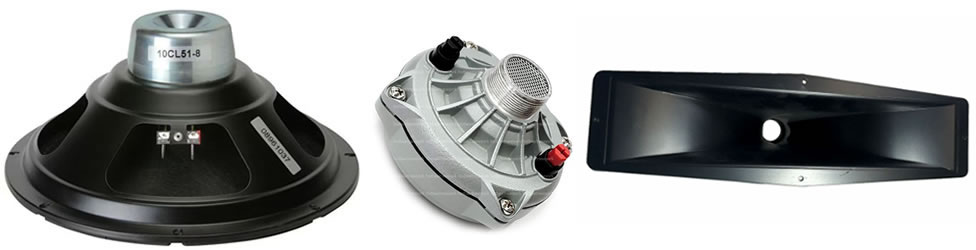
EV 8HD + Selenium D250X with B&C 10CL51
Vintage 8HD Frequency Responses

As I mentioned in my previous post, I bought a pair of 8HD off eBay 5 years ago. I was very hesitant to work on them due to their ragged frequency responses seen above. On the Left is from the EV Aristocrat loudspeaker and on the Right is the 8HD with the T10A compression driver.
This is compounded by the lack of compression drivers. I was not in favor of buying the T10A or the T25A which is by now is about 70 years old. That meant I will have to find a midrange driver to match the 8HD. So they set on my shelf for years while I worked on other projects.
Fortunately, after testing the Selenium D250X with the Klipsch K-700, I now have a midrange compression driver in my collection. This post is about mating of the D250X with the EV 8HD. If it works, another vintage horn will not fade into oblivion.
the Intricacies of Horns
Working with horns is far more difficult than with dome tweeters. First, one must find the best compression driver to go with the horn. If not, it’s a waste of time. The next challenge is whether one can shape the response. This is where the crossover comes in.

The Black plot above is the RAW response of the 8HD with the D250X. It looks rather intimidating to the uninitiated. The Red plot is with a High Pass Filter that I worked out.
Putting it All Together – the Bunting IV
 Fig 1 – EV 8HD with D250X with HP (Red plot) | B&C 10CL51 woofer with LP (Blue plot) Fig 1 – EV 8HD with D250X with HP (Red plot) | B&C 10CL51 woofer with LP (Blue plot)
Fig 1 shows the plots of the B&C 10CL51 woofer with the 8HD/D250X combo. They appear to be crossing at about 800Hz acoustically. That is where the 8HD cut-off frequency is.
 Fig 2 – Summation Region Fig 2 – Summation Region
The Black plot in Fig 2 shows the summation of the two drivers. It is very smooth except for a light cancellation at 1.5kHz.
 Fig 3 – Bunting IV NULL Response Fig 3 – Bunting IV NULL Response
Fig 3 is the Bunting IV Null Response. The notch is at 820Hz which is near my targeted frequency of 800Hz. It is also very deep and symmetrical, indicating the horn combo and the woofer are time-aligned.
 Fig 4 – Bunting IV Frequency Response Fig 4 – Bunting IV Frequency Response
Fig 4 is the Summed response of the Bunting IV. This is a remarkable plot. Note the flatness from 500Hz~6kHz.
 Fig 5 – Bunting IV Waterfall Fig 5 – Bunting IV Waterfall
As expected, the peaks at 7kHz and 12kHz are recorded in the Waterfall plot (Fig 5). What we’re seeing now is their artifacts.
 Fig 6 – Bunting IV Toneburst Energy Storage Fig 6 – Bunting IV Toneburst Energy Storage
The Toneburst plot (Fig 6) recorded excess energy (light blue slices) from 5kHz~15kHz. Those are the artifacts seen in the Waterfall.
 Fig 7 – Bunting IV Spectrogram Fig 7 – Bunting IV Spectrogram
In the Spectrogram (Fig 7), whatever artifacts from 2kHz upwards are fully dissipated by 2 msec. Basically inaudible. It is those from 1kHz~2kHz which may end up “shouty”.
 Fig 8 – Bunting IV Step Fig 8 – Bunting IV Step
The Bunting IV Step response (Fig 8) indicates the 10CL51 woofer is ahead of the D250X compression driver.
 Fig 9 – Bunting IV Excess Phase Fig 9 – Bunting IV Excess Phase
The Excess Phase is not too shabby, only 2 glitches, one at 600Hz and the other at about 1.7kHz. Best to avoid using EQ at these two spot frequencies.
 Fig 10 – Bunting IV Harmonic Distortion Fig 10 – Bunting IV Harmonic Distortion
The Bunting IV has an impressive Harmonic Distortion. This is what the distortion plot should look like. The 2nd harmonic is -52.7dB below the fundamental and dominates from 1kHz~20kHz. She is totally different from the Bunting III seen below (Fig 11).
 Fig 11 – Bunting III Harmonic Distortion Fig 11 – Bunting III Harmonic Distortion
Cause of Distortion
Initially, the Distortion of the Bunting IV looks exactly like the Bunting-III. That’s not surprising because I’ve already determined that the problem stems from the D250X and not from the 8HD. I dis-assembled the compression driver on my work bench to check for debris (iron filings) in the voice coil gap. I had that bad experience before with a Dayton D250P so that’s my first suspect. After inserting a piece of paper and wiping the gap a few times, I found it to be completely clean.
Next, I inspected the voice coil. It is not distorted and does not contain any debris. Now, I’m in a bit at a loss.
While re-assembling the compression driver, I noticed I had to apply extra force to two of the four screws that hold the bottom and top halves of the body together. That’s when I opened the clam shells again to examine whether they need to be aligned properly before screwing them back. True enough, there’s only one position where the top and bottom halves are in perfect alignment. Strangely, there are no markings on the body for this. I bought this Selenium D250X new therefore, I can only surmise that the factory did not assemble it properly. Once I got the clam shells properly aligned, the Harmonic Distortion is what I expected (Fig 10).
Bunting IV Crossover Fig 12 – BUNTING IV Crossover Fig 12 – BUNTING IV Crossover
The Bunting IV crossover is very elegant. The 8HD/D250X has only a 2nd order network. The B&C 10CL51 woofer is also a 2nd order but has a Zobel tagged on. When you have the right drivers to work with, you don’t need to fight fires.
Bunting IV Impedance Fig 13 – BUNTING IV Impedance Fig 13 – BUNTING IV Impedance
The Bunting IV Impedance is in Fig 13. Her Nominal Impedance is 8Ω. There is a single peak close to 2kHz. During auditioning, I didn’t detect any issues there. The Bass Reflex box is tuned to slightly below 50Hz.
Sound of Bunting IV
In auditioning, I always use tracks that will flag me if there are issues. One of them is How Am I Supposed to Live Without You (Michael Bolton). With some speakers, his voice can be irritating at times. Not with the Bunting IV.
Another track I like to play is The Girl In The Other Room (Diana Krall). This is quite a demanding track. If the crossover is not right, I can hear the compression driver resonating. It manifests as a sustained note, particularly in piano. None of that happened with the Bunting IV. Also, sibilance was natural, not exaggerated. That is attributed to the flatness in the lower treble. Farther up, the treble is exquisite, not bright or harsh.
Summary
I was stunned with the performance of the 8HD/D250X combo. I never expected a horn made in 1950s can still stand amongst the best after 70 years.
So the problem was not the horn. I proved that it was bad matching of the compression driver. It is only by chance that I have a Selenium D250X in hand. Otherwise, the EV 8HD will end up as a relic of a forgotten era or worse still, in a landfill.
Unless otherwise stated, all measurements were made in Full Space (4pi). Mic at 36 ins, tweeter axis. Impulse Window=5ms. No smoothing applied. |