NM-6 (Natural Music)
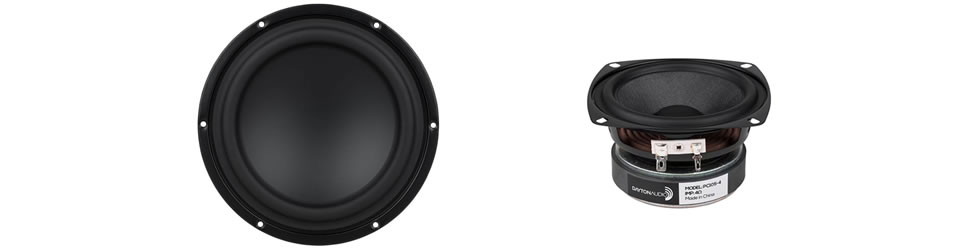
Dayton PC105-4 with HiVi M8N-1B Sub
The NM-6 continues the development the NM (Natural Music) Series that I first worked on in Aug 2024. The idea behind this NM design is to use a small Full Range driver and support her with another woofer doing bass only. I find this approach results in the most natural sounding music, hence the moniker NM. It mimics time and phase coherent loudspeakers pioneered by the likes of Thiel, Dunlavy, Vandersteen and others.
In this NM-6, I’ve chosen the PC105-4, a 4″ Fullrange driver by Dayton. After testing her out in my previous post, I found her response to be the flattest compared to all the other Full Range drivers that I used before.
For bass duty, I decided on the M8N-1B, an 8″ Aluminum/Magnesium cone woofer by HiVi. A major departure from all the other NM designs is the NM-6 is not a single 2-way box. Instead, the PC105-4 is a satellite whilst the M8N-1B is a 24 liter Ported Sub.
 Fig 1 – Dayton PC105-4 Frequency Response in 7L Ported Box (Baffle Width=8″) Fig 1 – Dayton PC105-4 Frequency Response in 7L Ported Box (Baffle Width=8″)
Fig 1 is the RAW Frequency Response of the Dayton PC105-4 in a 7 liters ported box. This is the only Full Range driver that exhibits the least baffle step. This is important because as a minimalist design, I am against incorporating a passive EQ to tame the baffle step. Obviously on her own, the bass is not loud enough. After all, she’s only a 4″.
 Fig 2 – PC105-4 with HiVi M8N-1B Sub Fig 2 – PC105-4 with HiVi M8N-1B Sub
Fig 2 is the frequency response of the PC105-4 with the M8N-1B Sub placed on the floor. Note the difference the Sub made in the bass. Ignore the notch at about 125Hz. That is caused by a floor bounce in my microphone setup. Measurements below 500Hz include room reflections.
 Fig 3 – HiVi M8N-1B Sub Port Response Fig 3 – HiVi M8N-1B Sub Port Response
The plot in Fig 3 is with the microphone positioned at the entrance of the port. This was made with a 10mH Low Pass filter. That is the only component used in the NM-6.
the MN-6 System
 Fig 4 – NM-6 Setup Fig 4 – NM-6 Setup
The diagram above shows how the NM-6 can be set up. The PC105-4 satellites can either be on stands, hung on the wall, on shelves or whatever is convenient. This system is not for critical listening. It’s more for general entertainment.
The two HiVi M8N-1B subwoofers are on the floor. This will result in the response in Fig 2.
Sound of NM-6
The sound quality is excellent, considering her minimalist concept and low cost. Though there are some “flaws” I detected during auditioning, in particular The Girl In The Other Room (Diana Krall). Her voice and the piano are a bit shouty and there’s a certain “hardness”. This “hardness” disappeared after break in.
I believe the shouty effect is from the rise in the response from 1kHz~2kHz. I can use a passive EQ to lower the amplitude but that would mean deviating from the minimalist concept. Another way is to use a Parametric EQ which means I’m adding electronics to the system. Considering the NM-6 is targeted towards the general public, I’m not convinced it’s worth to correct these “flaws”. Most listeners will not be able to hear them anyway. But for an academic exercise, I may work on them further. As it stands now, I managed to minimized these “flaws” by stuffing the port in the PC105-4 satellites. I may even convert it to a Sealed box if it helps..
the Final Touch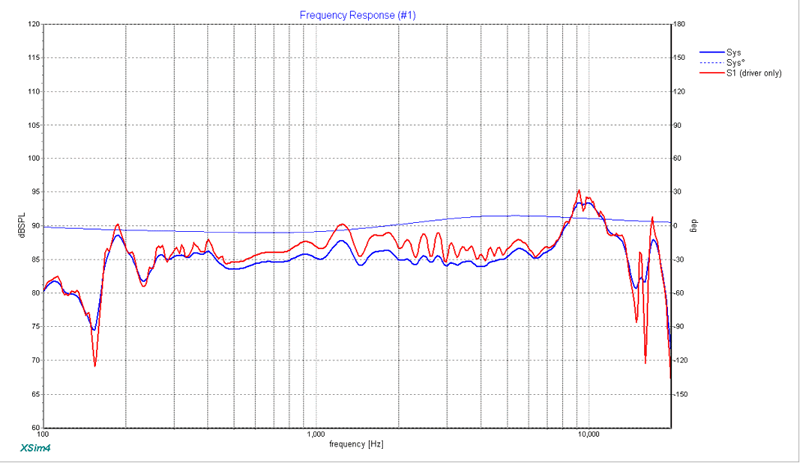 Fig 5 – NM-6 with Parallel Notch Filter Fig 5 – NM-6 with Parallel Notch Filter
After a couple of days, I couldn’t bear it any longer. I decided to EQ the PC105-4 response. The Red plot is the RAW response of the PC105-4. The Blue plot is with a Parallel Notch EQ. With this EQ, the PC105-4 sounds wonderful.
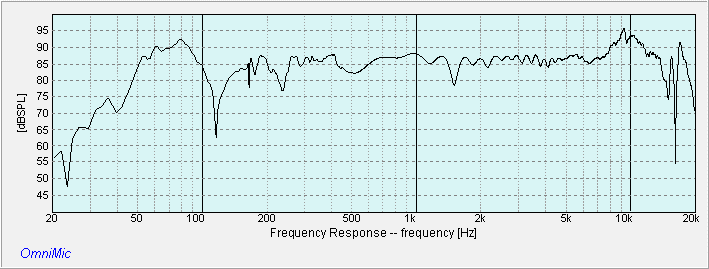 Fig 6 – NM-6 with 31-Band EQ Fig 6 – NM-6 with 31-Band EQ
Fig 6 is the PC105-4 response when I tuned her with a 31-Band Electronic EQ. I am now able to remove the two peaks at 1.2kHz and 1.8kHz but I ended up with a -6dB notch at 1.6kHz. It’s a small penalty to pay for leveling the peaks.
Does the NM-6 sound better than using the passive parallel notch network in Fig 5? Yes, it does but unless you are doing an AB test, it’s impossible to tell the difference. The reason I tested it with an electronic EQ is because in commercial applications, it is common to have a 31-Band EQ in the system. This exercise will give me an idea of how the NM-6 sounds in restaurants, pubs, fashion boutiques etc.
Summary
Overall, I am very pleased with the NM-6. Of all the designs in the NM Series, this NM-6 is the best in sound quality when EQ is applied. More than that, she’s very affordable. The Dayton PC105-4 is only $18.00 while the HiVi M8N-1B is listed at $40. Very little money for this level of performance.
Unless otherwise stated, all measurements were made in Full Space (4pi). Mic at 36 ins, tweeter axis. Impulse Window=5ms. No smoothing applied. |