|
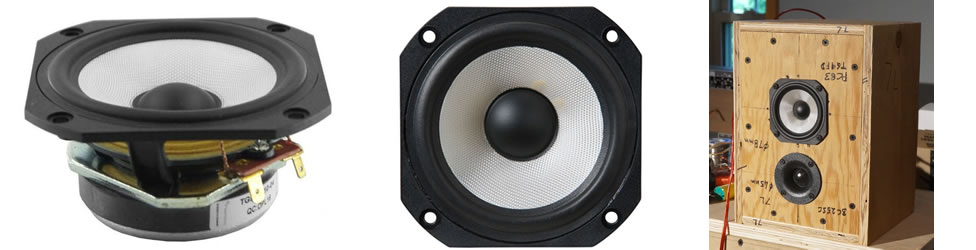
I hesitated for a long time in buying this 3-1/2″ Full-Range mainly because of her Qts of 0.72. My preference is 0.32 to 0.4 for bass reflex and 0.5 for sealed box. But since she cost only $18, I can write her off if she doesn’t meet my expectations. What appeals to me is her glass fiber cone and a copper cap in her motor to lower inductance and distortion. This copper cap is usually reserved for more costly models. It’ll be interesting to see how these features enhance her performance. Peerless Frequency Response Fig 1 is my measurement of the TG9FD10-08 mounted onto a 7 liters Bass Reflex box having a width of 8″. The tweeter shown is not used, only the TG9FD10-08. If the treble is grating, I can easily convert to a 2-way by connecting the tweeter. Overall, I am quite pleased with the response I got. Firstly, there’s the absence of the baffle step. That’s attributed to having a baffle width of 8″. She is fairly flat from 500Hz~15kHz. There is a bit of wriggle from 1.5kHz to 3kHz but nothing serious. Farther up is a 5dB rise at 10kHz. When listening at a distance, say 10ft or more, this rise will be less. The plot below 500Hz is not in Quasi-anechoic. It includes room reflections. I avoided splicing in a Near-field measurement because I wanted to see how low this woofer will go. Surprisingly, she goes down to 60Hz at -10dB from the fundamental. Below that, she falls off drastically. It’s incredible that a 3-1/2″ Full Range woofer is capable of going so low.
The Waterfall plot (Fig 2) shows artifacts at 9kHz. I would not worry too much as my windows is 2 msec.
The Toneburst plot (Fig 3) is similar to the Waterfall but the frequencies along the Z-axis is now in Cycles instead of Time. The light blue slices are the artifacts (Stored Energy).
The Spectrogram in Fig 4 is a 2D view of the Waterfall. At about 1.2kHz, a green streak is seen. From 2kHz~10kHz, the green streaks dissipate by 1 msec. I don’t expect to hear any harshness in the treble.
The Step response in Fig 5 recorded an exceptionally fast attack. Her peak is at an astonishing 24 microsec. She decays equally fast until she reaches 40%. Quite an impressive step.
The TG9FD10-08 Harmonic Distortion (Fig 6) is better than most. 2nd Harmonics is at -51.7dB below the fundamental. Her 3rd is even lower, coming in at -56dB. Auditioning I was shocked when I played music with this Peerless TG9FD10-08. I never expected her to sound this good. Her tonal qualities are excellent. The vocals in particular, are outstanding. In Fools For Love (Amanda McBroom), she came across clearly. No veil and not “Shouty”. Her sibilance is well controlled. No harshness detected. Born Free (Matt Monro) was recorded in 1966 when it’s all analog. The recording is not very clear yet with the TG9FD10-08, he sounded passable. With some drivers, he can sound muffled. Lastly, in Always On My Mind (Willie Nelson), his voice jumps out and is in the forefront. The instruments and backup singers are slightly behind. Summary Of all the Full-Range drivers I have, this Peerless TG9FD10-08 is the best. She is extremely affordable ($18 at PE) but don’t let the price fool you. She performs as well or surpasses woofers double the price. There are limitations with a 3-1/2″ Full-Range. With such a small woofer, the bass is a bit lacking. Even though her 60Hz is -10dB below her fundamental (Fig 1), the TG9FD10-08 still sounds natural. I should remind readers that my measurements are taken in Full Space (4 pi). In actual use, most listeners would place their speakers against the wall, in a corner or even on the floor. Any one of these will boost the bass, sometimes by as much as 6dB. If that’s still not sufficient, add a subwoofer. Then we’re looking at the NM Series. Unless otherwise stated, all measurements were made in Full Space (4 pi) with the mic at 36 ins, tweeter axis. Impulse Window=5ms. No smoothing applied. |
July 1, 2026Drivers Evaluation, HIFI DRIVERS
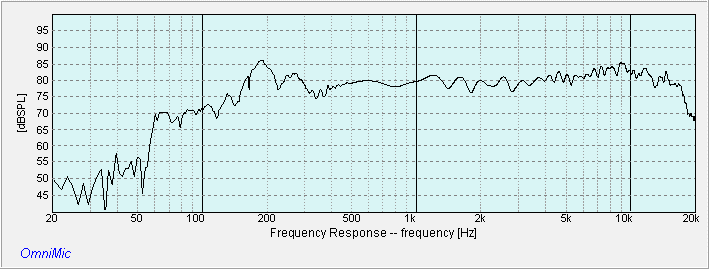 Fig 1 – TG9FD10-08 Frq Response • Baffle Width = 8″ • No Smoothing
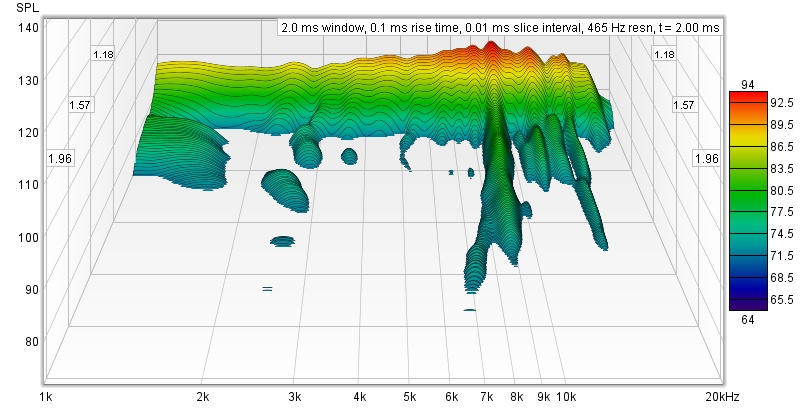 Fig 2 – TG9FD10-08 Waterfall
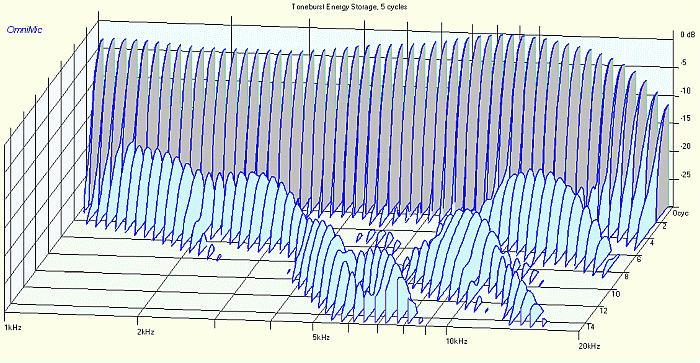 Fig 3 – TG9FD10-08 Toneburst Energy Storage
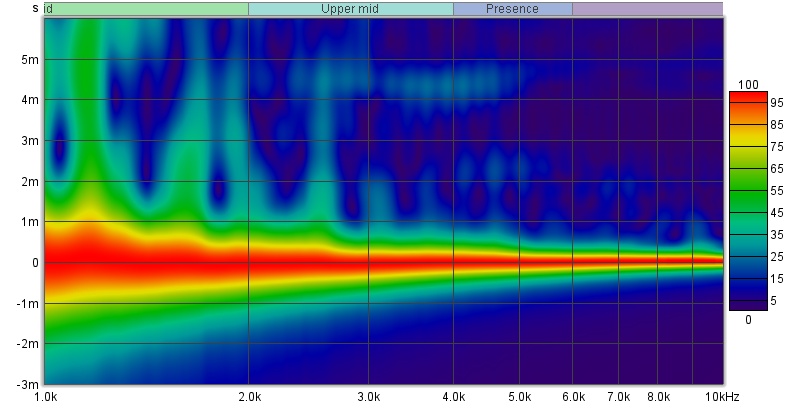 Fig 4 – TG9FD10-08 Spectrogram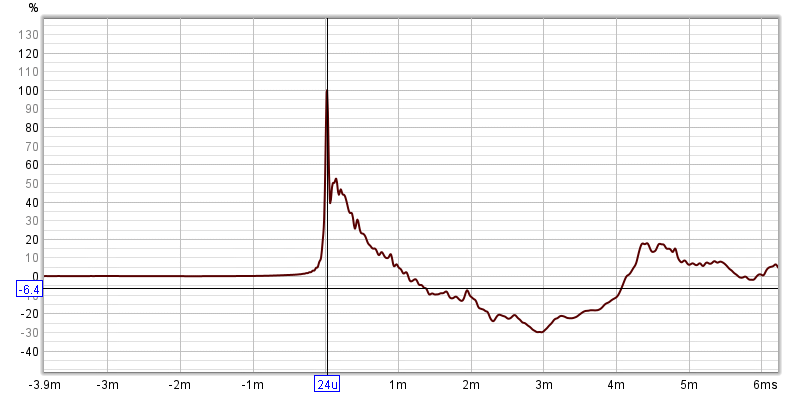
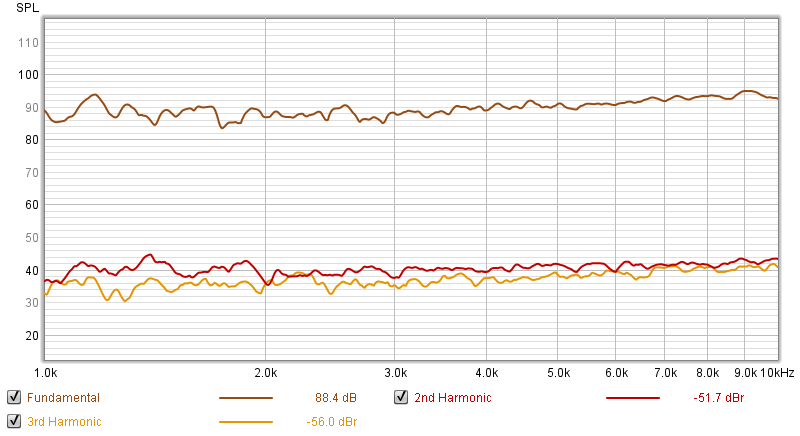 Fig 6 – TG9FD10-08 Harmonic Distortion