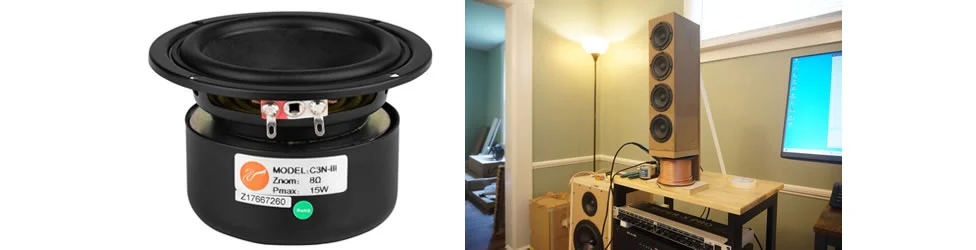
Array-C3N
HiVi C3N-III x4
Now that winter is finally over, I can get back to some speaker designs. First off the blocks is a simple Mini-Array inspired by my chance encounter with the Electro-Voice Evolve in 2023.
My Mini-Array consists of 4 units of 3″ full range woofers from HiVi, the C3N-III. I tested her out in August of the same year and was pleasantly surprised that her performance was very good considering her price.
I quickly glued up a small column with some scrape 1/4″ mdf to house 4 units of the C3N-III. Below is the frequency response of the array.
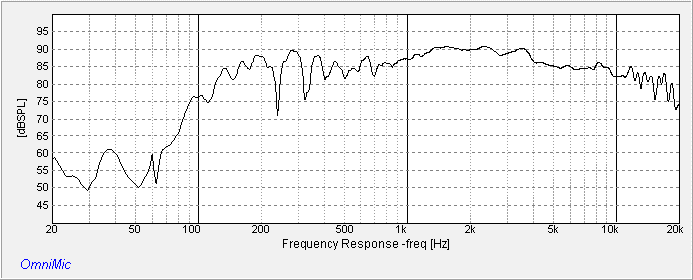 Fig 1 – Array Frequency Response at 1 meter, Center of Array, No Smoothing, 5ms Window Fig 1 – Array Frequency Response at 1 meter, Center of Array, No Smoothing, 5ms Window
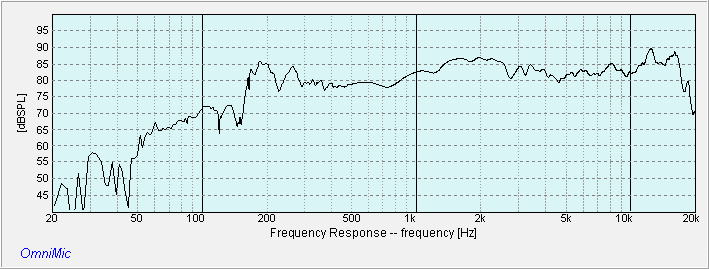 Fig 2 – Single C3N-III Frequency Response at 1 meter, No Smoothing, 5ms Window Fig 2 – Single C3N-III Frequency Response at 1 meter, No Smoothing, 5ms Window
What stands out immediately is the array’s response (Fig 1) looks different compared to when the HiVi C3N-III is measured alone (Fig 2). Most noticeable is the roll-off in the treble. At 10kHz, she is -5dB less when compared to the upper mids at 1.5kHz.
The Baffle Step is still visible due to the narrow baffle but it is now broader. It starts to climb at 1kHz and tapers off at 4kHz. This resulted in a +5dB emphasis in the upper midrange and lower treble region.
At the lower end, she rolls off at 150Hz. This is quite expected as the array is a sealed box.
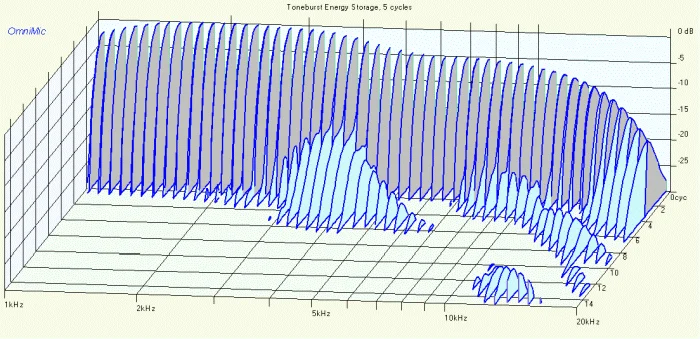 Fig 3 – Array ToneBurst Energy Storage at 1 meter, Center of Array Fig 3 – Array ToneBurst Energy Storage at 1 meter, Center of Array
Fig 3 is the ToneBurst Energy Storage plot. The light blue slices are the stored energy (artifacts). There is a concentration of stored energy at about 3.5kHz.
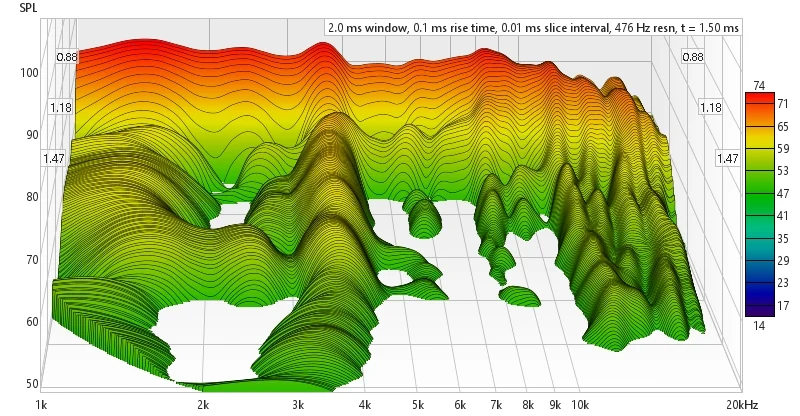 Fig 4 – Array Waterfall at 1 meter, Center of Array Fig 4 – Array Waterfall at 1 meter, Center of Array
Fig 4 is the Waterfall plot of the Array. The stored energy is visible at 3.5kHz and from 10kHz~20kHz in the upper treble.
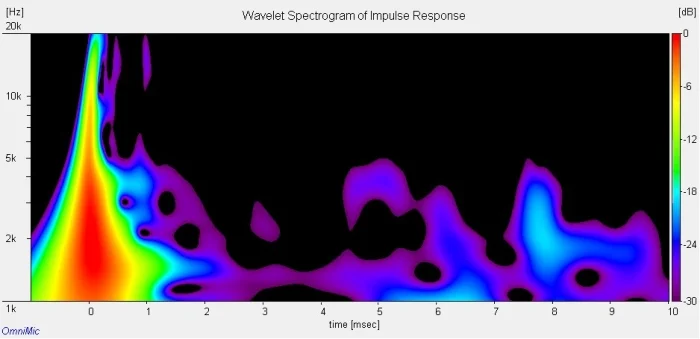 Fig 5 – Array Wavelet at 1 meter, Center of Array Fig 5 – Array Wavelet at 1 meter, Center of Array
In this Wavelet (Fig 5), I extended the time to 10ms. We can see most of the artifacts are from 1.5kHz which are recorded in the Waterfall plot. By 10ms, they are down about -30dB.
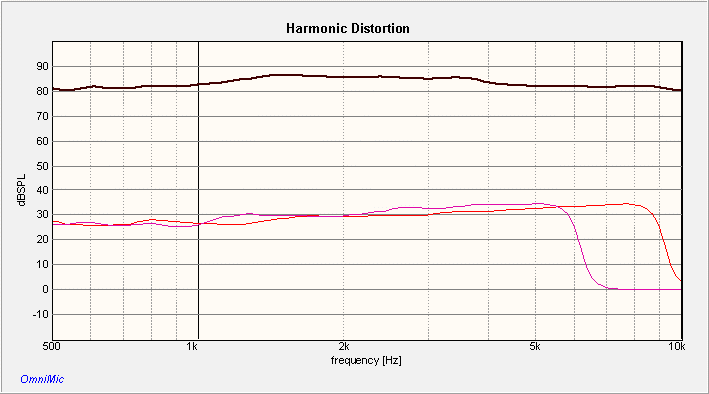 Fig 6- Array Harmonic Distortion at 1 meter, Center of Array Fig 6- Array Harmonic Distortion at 1 meter, Center of Array
The Harmonic Distortion (Fig 6) of the Array is quite impressive. Generally, the 2nd and 3rd harmonics are about -50dB below the fundamental.
Improving the Array
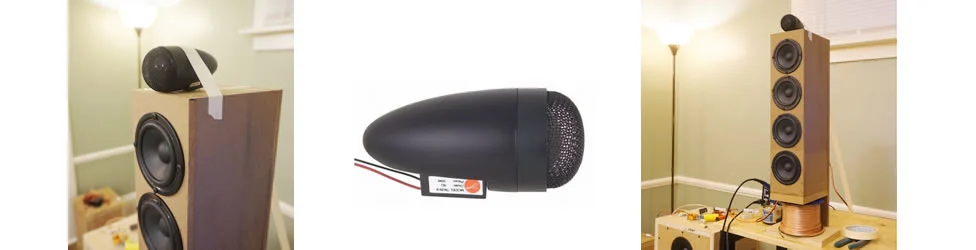
On her own, the sound of the Array is quite ordinary. After a few days of listening, I couldn’t stand it any longer, I added a tweeter. Since the baffle is already cut, the only place is to have the tweeter sitting on top.
Out came my HiVi TN28. To keep things simple, I opted for a minimalist 1st order crossover, a 5.6uF capacitor followed by a 4.7 ohm resistor for padding.
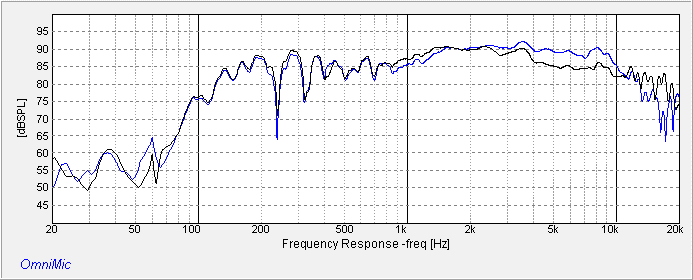 Fig 7- Black plot = Array without tweeter. Blue plot = with HiVi TN28 Fig 7- Black plot = Array without tweeter. Blue plot = with HiVi TN28
The Blue plot in Fig 7 is the new response with the TN28 tweeter. Now, the treble is restored. She is at the same level as the baffle step.
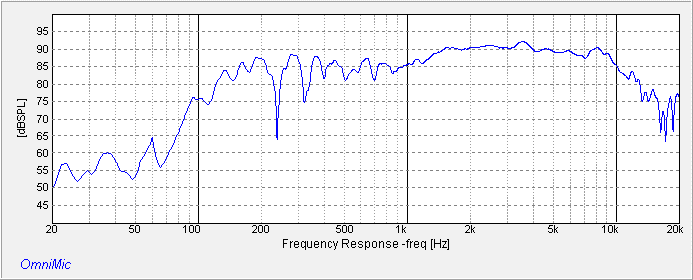 Fig 8- Array with HiVi TN28 tweeter added. Measured at 1 meter, Center of Array, No Smoothing Fig 8- Array with HiVi TN28 tweeter added. Measured at 1 meter, Center of Array, No Smoothing
Fig 8 is the final frequency response of the Array with the HiVi TN28 tweeter. Note the fairly flat response from 1.5kHz~8kHz. This Mini-Array must be used with a subwoofer. Without it, she is not listenable because she rolls of at 150Hz.
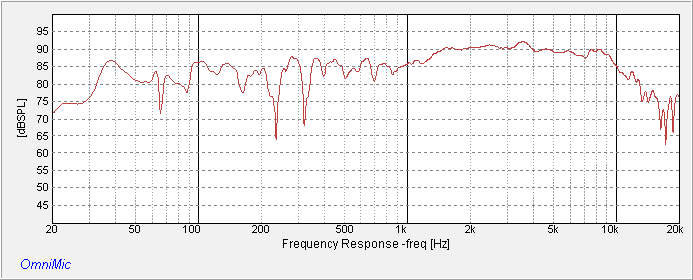 Fig 9- Subwoofer Added to Array + HiVi TN28. Measured at 1 meter, Center of Array, No Smoothing Fig 9- Subwoofer Added to Array + HiVi TN28. Measured at 1 meter, Center of Array, No Smoothing
The plot in Fig 9 is with an 8″ Dayton RS225-4 woofer low passed with a 24dB/oct electronic crossover at 150Hz. Since bass is room dependent, the loudness is adjusted by ear.
Sound of HiVi C3N-III Mini-Array + HiVi TN28 + Sub
The addition of the HiVi TN28 made a world of difference. Before that, the Array.was “Dull”, similar to Background Music in a shopping mall.
With the TN28, the music came alive. The vocals in particular, are outstanding. Clear and transparent. No veil. I can even make out the backup singers.
For the all important bass, the Dayton RS225-4 performed spectacularly. Her upper bass is articulate which to me is the most important aspect where bass is concerned. For the lower bass, she produced 40Hz effortlessly.
Summary
In the end, I’m very satisfied with this design considering the simplicity and cost. The HiVi C3N-III is only about $10 at PE. Four units add up to $40. The TN28 is $20 and the Dayton RS225-4 is at $85. Total driver’s cost is $145 per speaker. The capacitor for the tweeter is marginal.
For the sub, an electronic crossover and a power amplifier is needed. An alternative solution is to use one of those plate amplifiers like the Dayton SPA250DSP. It is equipped with a digital crossover and the amplifier is rated for 250W into 4 ohms. I have one in hand waiting to be bench tested. Hopefully, I can get it done in the coming weeks.
Last but not least, the Array on her own makes a great sound bar for a center speaker in a Home Theater setup. The L/R Main speakers can be the Array with the TN28 tweeter. As for the subs, I’ll leave it to the users to choose their own woofers.
Unless otherwise stated, all measurements were made in Full Space (4pi). Mic at 36 ins, tweeter axis. Impulse Window=5ms. No smoothing applied. |