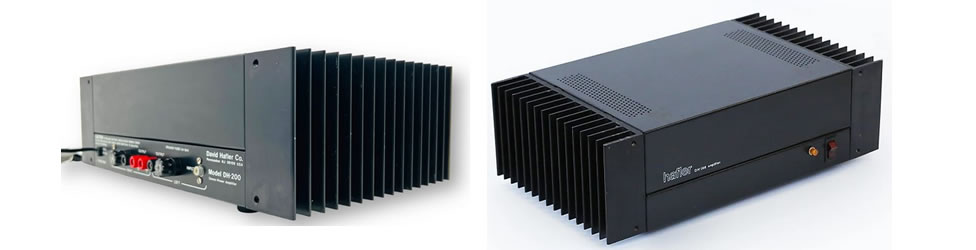
Hafler DH-200
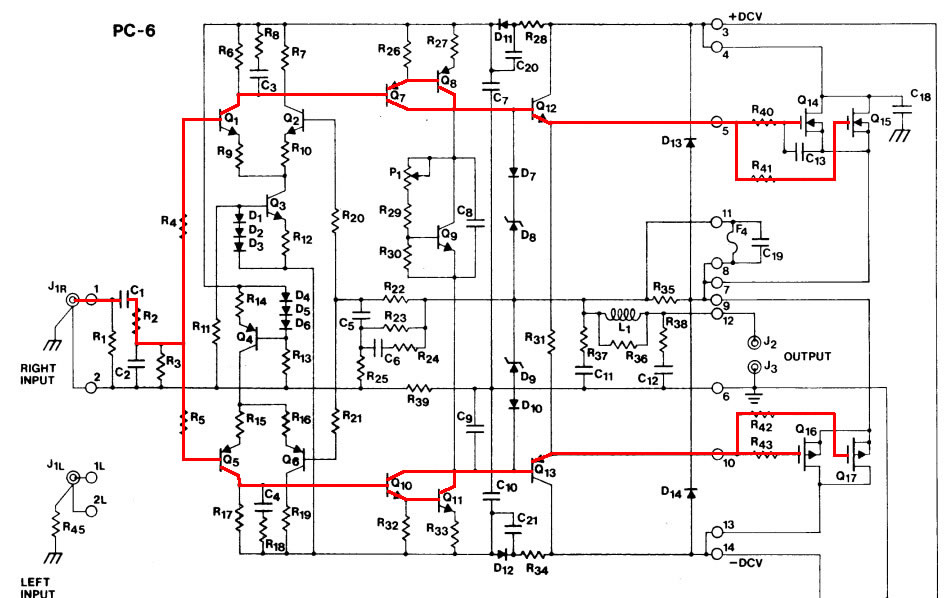
Hafler DH-200 Power Amplifier In Fig 1, we can see how the input section results in symmetry further down the line. Two differentials are used, one a NPN while the other uses PNP bi-polar transistors. The incoming signal is injected into the bases of these two differentials (Red line). After this, it drives the VAS with darlingtons. This is a nice touch as the darlingtons will not “load” the input differentials compared to using a single transistor. After the VAS, it’s pretty conventional. A pair of drivers are used to drive the power mosfets. This topology is very similar to the SAE 3100 except that in the 3100, there’s no darlingtons in the VAS. The other difference is the 3100 uses bi-polar outputs instead of lateral mosfets. Summary One of the problems when restoring the DH-200 is the unavailability of the 2SK134 and 2SJ49. Hitachi has long discontinued manufacturing them. They have been superseded by the plastic package 2SK1058 and the 2SJ162. Replacing them with these new flat-packs is not so easy. The elderly 2SK134 and 2SJ49 are TO-3 types whereas the new 2SK1058 and 2SJ162 are TO-3P. If your Hafler DH-200 mosfets are still good, then you’re in luck. Change the voltage drive board to a new one, solder in the lateral mosfets and you’ll be fine. If you cannot reuse the mosfets because they are damaged, then a viable option is to replace them with TO-3 bi-polar transistors. The circuit will of course need to be tweak for bi-polars. Die hard Hafler fans will object to this but either that or have your Hafler sitting in the basement. You can’t have it both ways. Some owners think that using bi-polars instead of lateral mosfets will degrade the sonic qualities of the DH-200. I firmly disagree. It all depends on the designer. |
July 29, 2025Amplifiers, Electronics