Vintage Peavey CS800
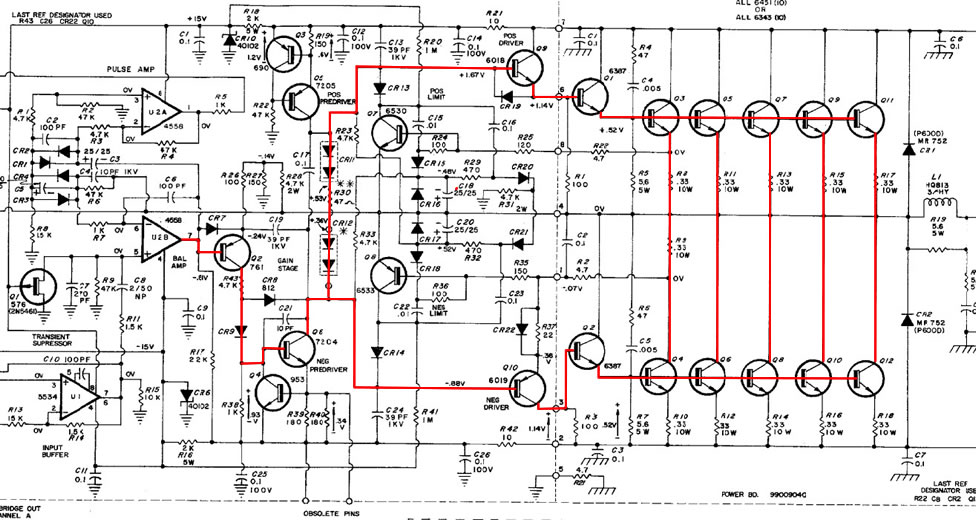
Vintage Peavey CS800 Right at the front, she was driver by a 4558 op-amp.At that time, this op-amp was very popular. Nowadays, there are much better ones but we are talking about 50 years later. This 4558 drives a transistor with a collector load of 1kΩ. We can look at this as one half of an input differential. She then drives the VAS with a Constant Current Source at the top. Bias for the current stage is via four diodes connected to the heatsinks. There are no provisions to bias the outputs further. So basically, the CS800 is operating almost in Class B when idle. The most notable aspect in this vintage is the Quasi-complementary configuration in the output. Engineers of that time didn’t have a choice because only npn power transistors were available. To get the bottom half to work, they had to resort to a level shifter (Q10). Without this, the Quasi will not work. Such designs do have inherent weaknesses, mainly stemming from the level shifter part. If not careful, the amplifier can be unstable, leading to catastrophic failure. Apparently, Peavey did an excellent job unlike the Phase Linears which had gained a notorious reputation for dramatic pyrotechnics when she blows up.
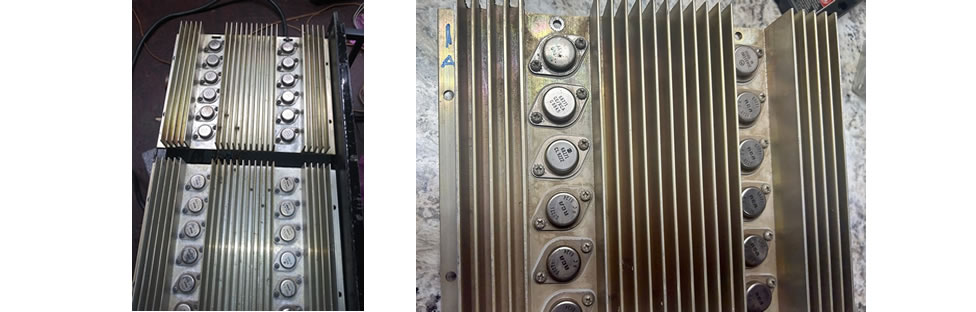
Fig 2 – Vintage Peavey CS800 Heatsinks The vintage CS800 was blessed with two large heatsinks to draw heat away from the power transistors (Fig 2). You won’t see this in amplifiers made today. They cheapened everything to lower the cost for higher profits. Most of the time, they compromise the heatsinks and the power transformer. What the customers don’t know won’t hurt them. Summary This vintage CS800 are still being used today. It’s a testament to how well designed the amplifier. She’s not perfect though. Her transformer hums softly. Not an issue when up on stage with a band playing. For domestic HiFi, the hum is audible. The 4558 op-amp is “slow” by today’s standards. This results in the sound being quite ordinary. I’m nitpicking here because in 1976, there’s nothing to compare with. I have two units of this vintage CS800 more as a collection. They reminds me of the golden era in audio. Can they be upgraded for better sound? Most certainly but it may not be worth the cost. |

August 11, 2025Amplifiers, Electronics