|
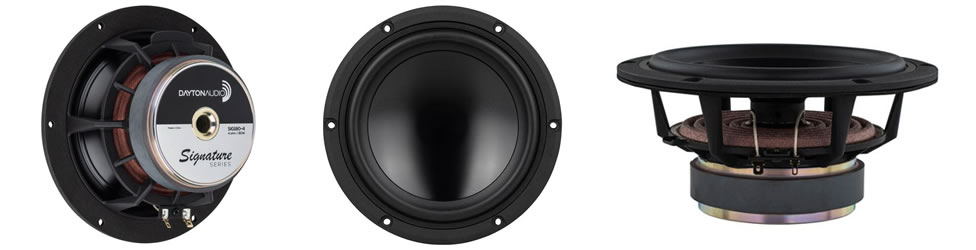
The SIG180-4 belongs to Dayton’s Signature Series. It is targeted for audiophiles, in other words, users that demand the best. Some of the highlights of this woofer is a cast frame, an aluminum cone and a Klippel optimized BL symmetry. Dayton SIG180-4 Frequency Response Fig 1 is the frequency response of the SIG180-4 mounted onto a 20 liters bass reflex. Box is tuned to 50Hz using a 1-1/2″ diameter PVC tube with a length of 1-3/4″. Her response resembles that in Dayton’s spec sheet. The plot below 500Hz includes room reflections. It shows that even in Free Space (4pi), she goes down to 50Hz. Above 500Hz, the plot is Quasi-anechoic. She is virtually flat from 500Hz to 3kHz after which she drops of drastically.
I normally set the Time Window at 2 msec so that I have a magnified view of the treble. Since the SIG180 is not a tweeter, I decided to set it at 6 msec. This will show more of the woofer’s behavior. In Fig 2, we can see the artifacts emitting from 1kHz.
The Toneburst plot (Fig 3) captured some stored energy (artifacts) at 3kHz. This is where there’s a slight peak seen in Fig 1. These artifacts are insignificant because they don’t contain much energy. Furthermore, I intend to cross to between 2kHz to 2.5kHz to the tweeter.
The Spectrogram in Fig 4 shows the artifacts from 1.8kHz to 20kHz are dissipated by 2 msec. There are a few green streaks from 1Khz to 1.5kHz but they lose they energy by 6 msec.
The attack of the SIG180 is not as fast as I would like (Fig 5). The peak registered at 116 microsec. This is without any crossover.
The Harmonic Distortion (Fig 6) is a bit strange. Generally, the 2nd harmonic dominates but at 2kHz~4kHz, the 3rd is greater. I plan to cross at 2kHz, so hopefully the offending 3rd harmonic would not be an issue. Unless otherwise stated, all measurements were made in Full Space (4 pi) with the mic at 36 ins, woofer axis. Impulse Window=5ms. No smoothing applied. |
July 20, 2026Drivers Evaluation, HIFI DRIVERS
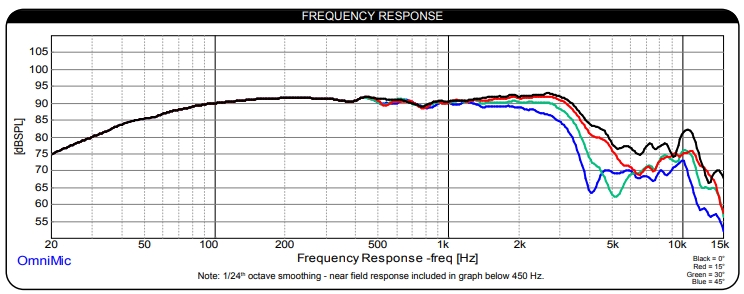
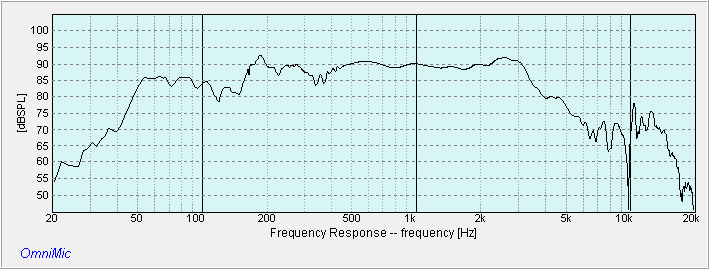 Fig 1 – Dayton SIG180 Frq Response • No Smoothing • Mic on axis
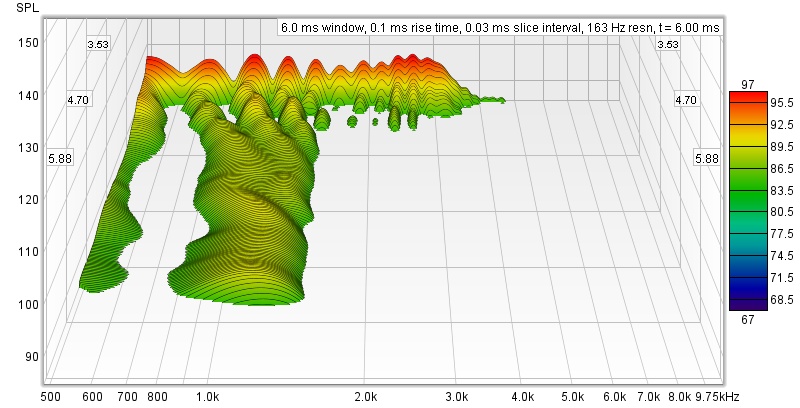 Fig 2 – Dayton SIG180 Waterfall
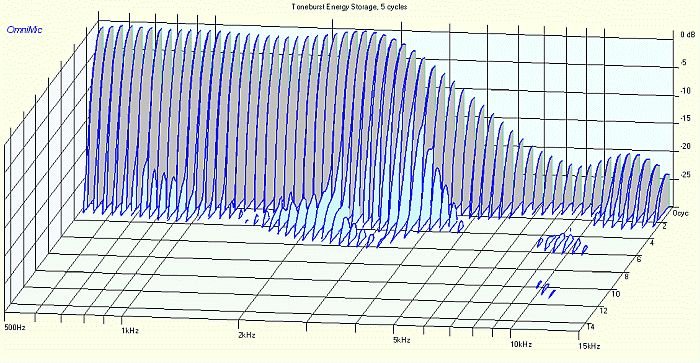 Fig 3 – Dayton SIG180 Toneburst Energy Storage
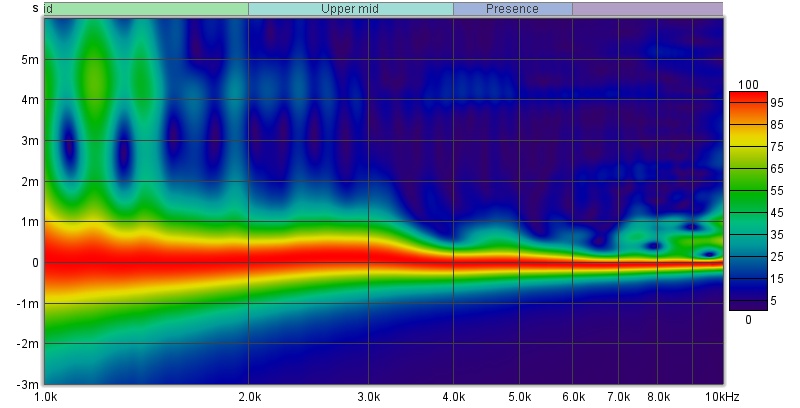 Fig 4 -Dayton SIG180 Spectrogram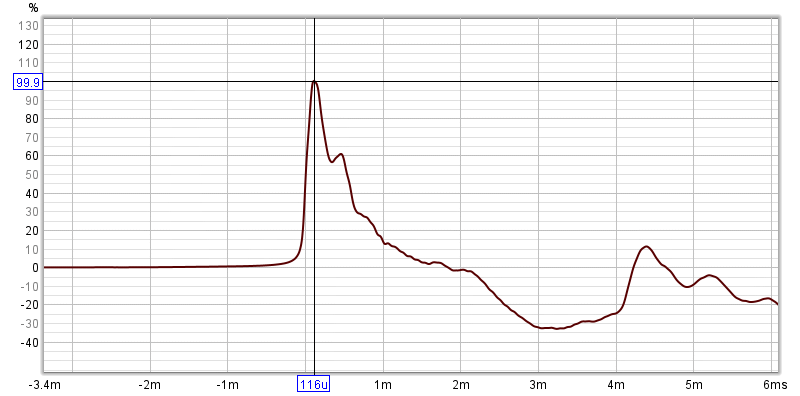
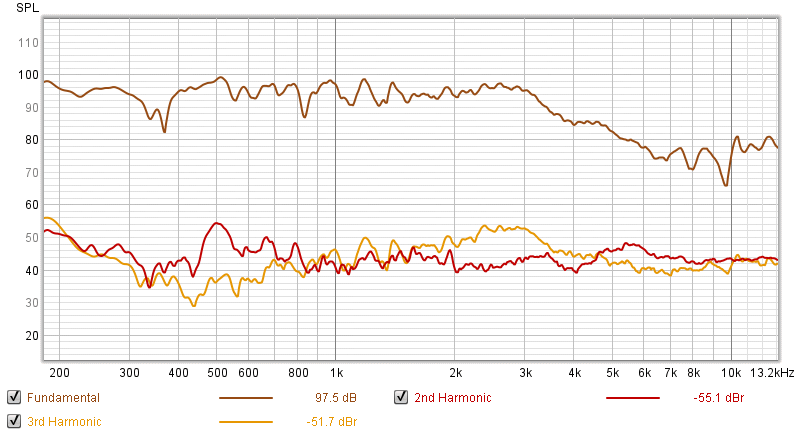 Fig 6 -Dayton SIG180 Harmonic Distortion