|
In the previous Osprey BR-II, I was so impressed by the sound quality of the Celestion CDX1-1446 compression driver that I decided to match her with one of my favorite horns, the Dayton H6512. Many of you may know that this Dayton is a copy of the JBL horn that’s used in their JRX Series loudspeakers.
Fig 1 is the RAW response of the CDX1-1446 mounted onto the Dayton H6512. No crossovers were used in this measurement. However, to protect the CD, she was swept with a signal that has the bass removed. We can see the horn cuts off at about 1.7kHz.
Fig 2 is the Impedance plot of the combo. It is encouraging to see a friendly resonance peak at 1,727Hz.
The Waterfall plot in Fig 3 recorded minimal artifacts in the treble.
Fig 4 is the ToneBurst plot of the combo. In this plot, the artifacts are presented as unwanted energy (light blue slices). The Z-axis is now in cycles.
The Spectrogram (Fig 5) is a 2D representation of the Waterfall and the ToneBurst plots. From 2kHz onwards, the artifacts are dissipated by 2msec. Between 1kHz~2kHz, there are a few green streaks but they dissipate by 6msec.
The 3rd harmonic distortion is at -54.2dBr (Fig 6). The dominant harmonic is the 2nd at -45.8dBr. I expect these harmonics to be lower once I use a crossover. Unless otherwise stated, all measurements were made in Full Space (4 pi) with the mic at 36 ins, tweeter axis. Impulse Window=5ms. No smoothing applied. |

October 9, 2024Drivers Evaluation, PRO DRIVERS
 Fig 1 – Celestion CDX1-1446 with Dayton H6512 RAW Frequency Response. No smoothing applied. Mic at 24 ins.
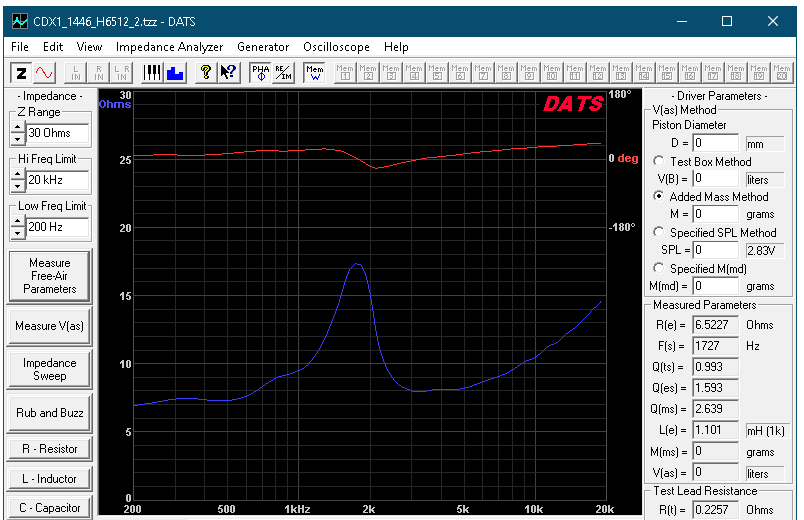 Fig 2 – Celestion CDX1-1446 with Dayton H6512 Impedance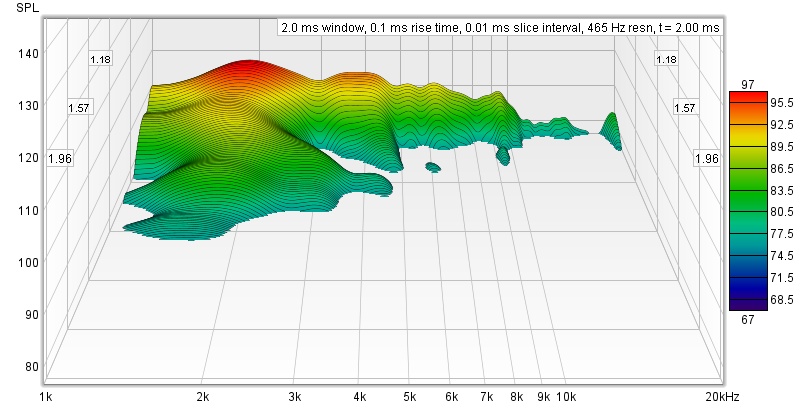
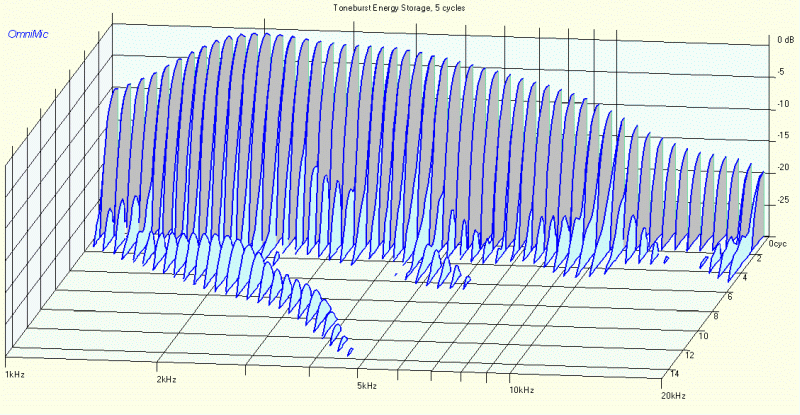 Fig 4 – Celestion CDX1-1446 with Dayton H6512 ToneBurst Energy Storage
 Fig 5 – Celestion CDX1-1446 with Dayton H6512 Spectrogram
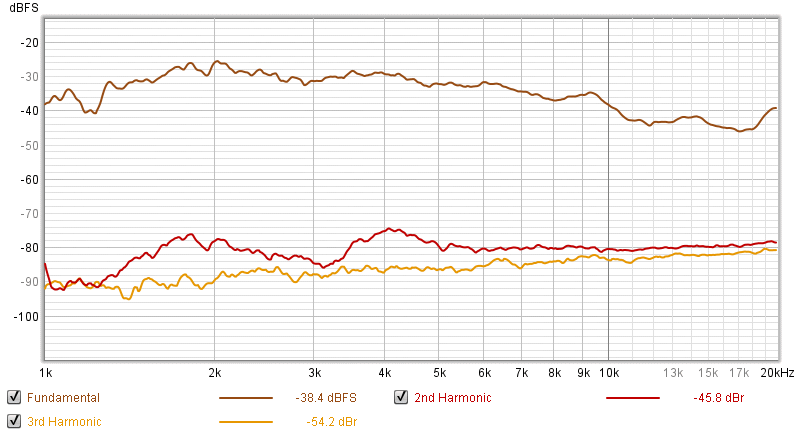 Fig 6 – Celestion CDX1-1446 with Dayton H6512 Harmonic Distortion