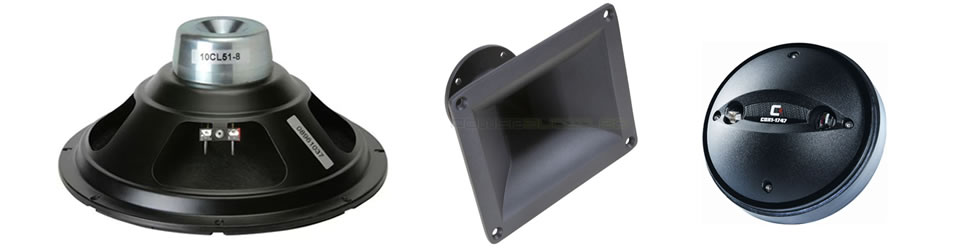
Kestrel-10CL
Celestion CDX1-1747 / LaVoce HD1004 with B&C 10CL51
The Kestrel-10CL is the first 10″ woofer I’m mating with the CDX1-1747/HD1004 horn combo. The woofer I’ve chosen is a B&C 10CL51, a 10″ with a Neodymium magnet. After reviewing her in my previous post, I’m confident they will make an excellent pair.
 Fig 1 – B&C 10CL51 – RAW (Black plot) • Low Pass (Blue plot) Fig 1 – B&C 10CL51 – RAW (Black plot) • Low Pass (Blue plot)
The Black plot in Fig 1 is the RAW response of the 10CL51. The Blue plot is with a Low Pass filter. I’m pleased to see the dip at 2.2kHz has been suppressed. It should not interfere when I sum it with the horn.
 Fig 2 – B&C 10CL51 Low Pass • CDX1-1747 with HD1004 High Pass Fig 2 – B&C 10CL51 Low Pass • CDX1-1747 with HD1004 High Pass
The Red plot in Fig 2 is the CDX1-1747 with the LaVoce HD1004 horn with a high Pass filter. Acoustically, they are crossing at about 1.9kHz.
 Fig 3 – Crossover Summation Fig 3 – Crossover Summation
The Black plot in Fig 3 is the summation of the High Pass and Low Pass. No cancellations are observed in the crossover region. The 2.2kHz dip in the 10CL did not create any null in the crossover region.
 Fig 4 – Kestrel-10CL Frequency Response Fig 4 – Kestrel-10CL Frequency Response
Fig 4 is the final frequency response of the Kestrel-10CL. Her response is incredibility flat from 1.5kHz to 13kHz (+- 3dB). I expect a very smooth treble.
 Fig 5 – Kestrel-10CL Null Response Fig 5 – Kestrel-10CL Null Response
Fig 5 is the Null response when the tweeter wires are in-phase. A deep notch is recorded at 1.9kHz. This indicates the alignment of the woofer and the horn combo is excellent.
 Fig 6 – Kestrel-10CL Waterfall Fig 6 – Kestrel-10CL Waterfall
The Waterfall plot (Fig 6) does not record any audible artifacts in the treble (2kHz upwards). This is a highly magnified view, a 2msec window. In practice, the artifacts are inaudible.
 Fig 7 – Kestrel-10CL Toneburst Energy Storage Fig 7 – Kestrel-10CL Toneburst Energy Storage
The light blue slices are the stored energy (artifacts) in this Toneburst plot (Fig 7). The difference is the z-axis is now in cycles instead of time. It appears that at 4kHz upwards, there are a lot of artifacts but in reality, they are insignificant.
 Fig 8 – Kestrel-10CL Spectrogram Fig 8 – Kestrel-10CL Spectrogram
The Spectrogram (Fig 8) shows the artifacts in 2D. From 1kHz onwards, the artifacts are inaudible because they dissipate by 2msec. This shows the artifacts are not strong enough to affect the music.
 Fig 9 – Kestrel-10CL Step Fig 9 – Kestrel-10CL Step
The Kestrel-10CL Step (Fig 9) shows an excellent attack and decay in the horn combo. Furthermore, the acoustic centers of the two drivers are very close. This is an indication of good time alignment.
 Fig 10 – Kestrel-10CL Distortion Fig 10 – Kestrel-10CL Distortion
The Kestrel-10CL Distortion (Fig 10) is the best in all the Kestrels. Generally, the 2nd and 3rd harmonics are at -55dB below the fundamental. Best of all, it’s the 2nd harmonic that dominates.
 Fig 11 – Kestrel-10CL Excess Phase Fig 11 – Kestrel-10CL Excess Phase
Fig 11 is the Excess Phase of the Kestrel-10CL. There is no sign of an inversion at 2kHz (the crossover region). Typically, a plot like this indicates good phase alignment between the woofer and the horn combo.
Summary
The Kestrel-10CL is the best when compared to all the previous versions with 8″ woofers. The vocal clarity is superb. Very transparent. The treble is smooth, no brittleness or harshness. Bass is naturally slightly lacking but a pro 10″ 2-way is primarily a mid-high unit. For full range, add a bass bin to extend the bass to 50Hz. The system will “fly” for music.
This design can be used in Recording Studios due to her flatness in her frequency response and the alignment of the woofer and the horn combo. I am so impressed that I recommend her for HiFi and Home Theater use.
Unless otherwise stated, all measurements were made in Full Space (4pi). Mic at 36 ins, tweeter axis. Impulse Window=5ms. No smoothing applied. |