|
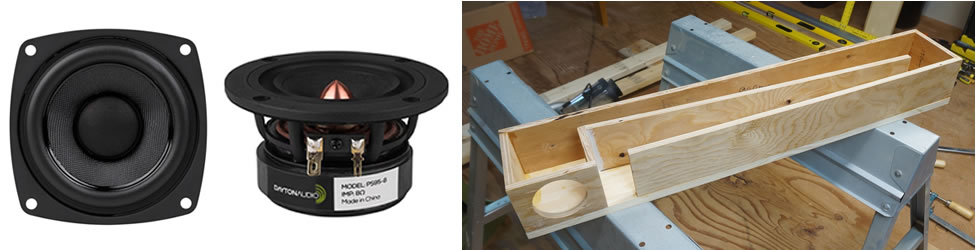
In my previous post, I touched on the idea of using the TQWT as a subwoofer to support a 3″ full range driver. This is the next stage to verify whether it is indeed possible and if so, how good can it be. Please note the tweeter is not used in the photo above. Only the PS95.
To recap, Fig 1 is the frequency response of the PC83-8 in a TQWT in my previous post. Notice the sharp peak caused by a standing wave at close to 300Hz. After that, the response of the PC83 rises and is peaky. Instead of trying to achieve a flatter response with filters, I decided to use the TQWT as a Subwoofer and add the Dayton PS95-8 Point Source to handle from 100Hz~20kHz.
Fig 2 is the response of the PC83-8 TQWT with a 12dB/oct Low Pass filter. This is the response of the TQWT Sub with the mic on-axis with the PC83. The roll-off after 250Hz is quite effective in suppressing the mids and highs.
Fig 3 is the TQWT Sub with the Dayton PS95 sitting on top as in the photo above. The PS95 response is a huge improvement over the one with the PC83 in Fig 1, so I’m on the right track. What is concerning is the notch at 150Hz and the peak at 250Hz. That standing wave is not subdued enough for my liking because I can still pick it out during auditioning even though it’s very soft.
After a couple of days listening to Fig 3, I decided to flip the TQWT Sub wires around and to my surprise, the response is exactly what I wanted (Fig 4). The notch at 150Hz disappeared and so did the offending 250Hz standing wave. Auditioning First off, this project is not for critical listening. It is meant for general listening where space is a constrain. As for how loud it can go, well it’s only a 3″ full-range driver with a sensitivity of 85dB. Great for soft background music while you work. Since the bass is not her strong point, I shall evaluate her with vocal tracks. The aim is to determine her midrange clarity and how smooth the treble is. I started of with a 1955 hit by The Platters – Only You. There were no issues with the vocals. Not shouty as one would normally encounter with a 3″ full-range mounted on a small baffle. I then moved on to Diana Krall – The Girl in the Other Room. Again, she was not “shouty”. Treble is a bit bright in certain passages. This is understandable because I did not treat the treble peak at 7.5kHz. I wanted to keep the filters to a minimum. The next track will show whether the standing wave is still there. I played Soul Provider by Michael Bolton. The bass is very distinct in this track. Fortunately, I did not detect any overly sustained bass. Georgia On My Mind passed with flying colors. Summary This project exceeded my expectations. To achieve this sound quality is quite astonishing. The Dayton PC83-8 cost only $15.50. The Point Source PS95-8 is twice as much at $30.00. Both from Parts Express. Granted the lower octaves are not loud but one can mitigate this by placing the combo nearer to the back wall. If more bass is still needed, consider corner placement. Bass is also room dependent. A small room (bedroom or office) will boost the bass. These are the variables when one is working with bass. Now that I have determined the feasibility of this project, I will proceed to build this TQWT with the PS95 integrated on top. |
June 18, 2026HIFI DRIVERS, Projects
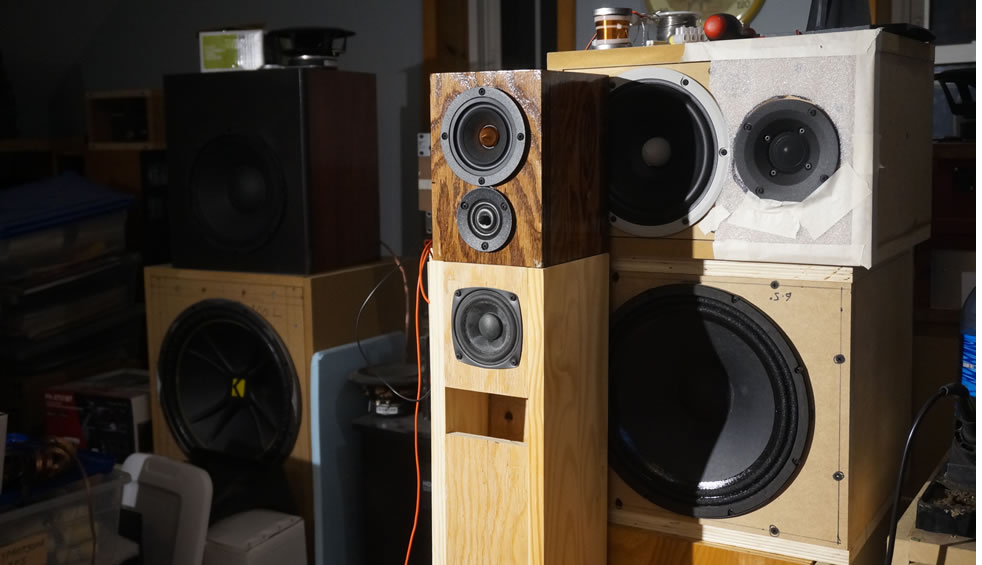
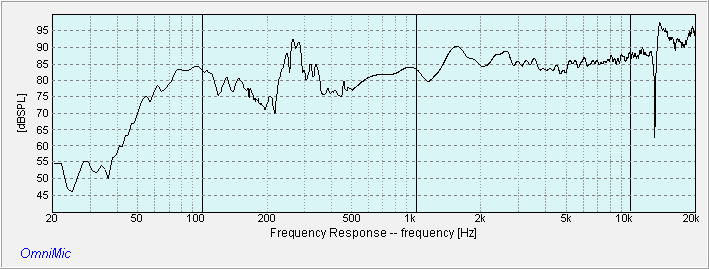 Fig 1 – PC83-8 TQWT Frequency Response (Mic on Axis with PC83)
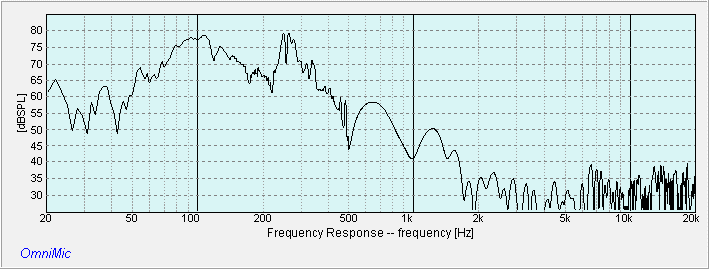 Fig 2 – PC83-8 TQWT with 12dB Low Pass (Mic on Axis with PC83)
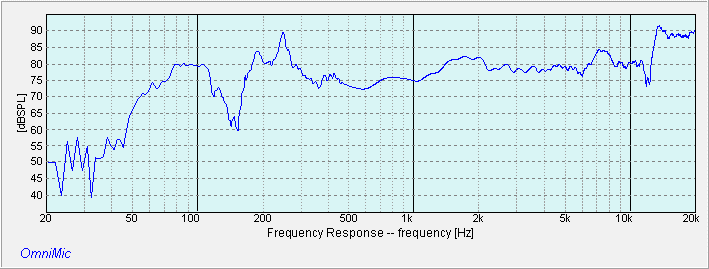 Fig 3 – PC83-8 TQWT with 12dB Low Pass with PS95 (Mic on Axis with PS95)
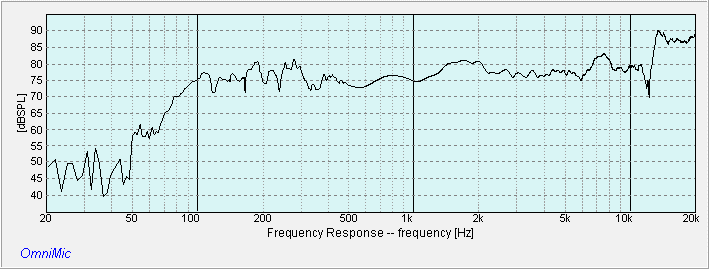 Fig 4 – PC83-8 TQWT with 12dB Low Pass (Reversed Phase) with PS95 (Mic on Axis with PS95)