|
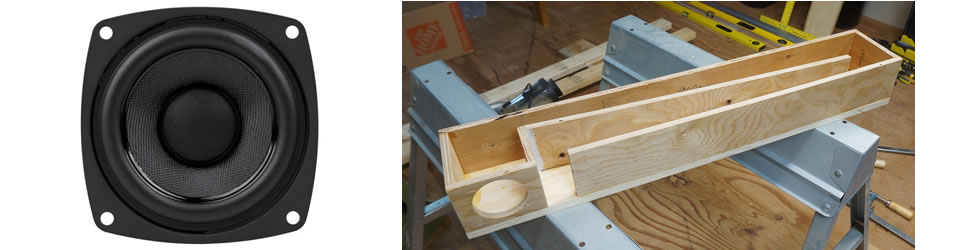
After almost 30yrs, this is the first time I’m building a TQWT (Tapered Quarter Wave Tube). This came about because I needed to test out a new table saw that I bought. I was tired of fighting with my old 10″ JET saw and I finally bought a SKIL for her precision. Since this is my first time building a TQWT, I didn’t know what to expect. I decided to use some scrap wood in case the TQWT is not to my liking. The photo on the right is what the TQWT looks like on the inside. The one on the left is when the last panel is glued in. I don’t think I’ve ever used so many clamps before. Auditioning the TQWT When I played music with the TQWT, I nearly dropped dead. It was the most horrendous music I’ve ever heard. The midrange was so blurry it sounds as though I’m in an echo chamber. After my initial shock, I discovered the cause. It was a strong standing wave between 300Hz~500Hz that’s messing up the vocals. This is unavoidable because of the length of the TQWT. It does give you a louder bass but the trade-off is a massive standing wave. The only way to avoid this is to reduce the height and have multiple folds instead of a simple single fold but it gets complicating after that.
The plot in Fig 1 is the frequency response of the PC83-8 when she’s mounted in a 7 liters Sealed Box. No equalization is used in this measurement.
Fig 2 is the frequency response of the PC83-8 in a TQWT. Measurement was made with the microphone on axis with the PC83-8. While the bass is louder, there is a strong peak at 300Hz. That is what a standing wave does when sound is in a pipe. It bounces up and down the pipe and in the process, a particular frequency is amplified.
Fig 3 is the response of the PC83-8 TQWT with the mic at the mouth of the horn. In this plot, the standing wave is even more pronounced. Summary I was utterly disappointed by this TQWT. There’s no way I can accept this kind of reproduction. I was left with the prospect of a slim tower that’s useless. Having mulled over this for a few days, I had a Eureka moment. What if I use it as a Subwoofer. If it works, I not only salvage my build but opens up a new avenue. I proceeded to install a 10mH iron core inductor as a Low Pass to filter out the mids and highs. A small satellite using a Dayton PS95-8 will handle the vocals and the treble. Is this idea workable? Definitely. It’s not perfect because I can still hear a bit of the standing wave but at least the TQWT is not in the dumpster. The concept is similar to my NM series. Instead of an external 8″ sub, it is a 3″ TQWT that’s doing the bass. To integrate them together, all I have to do is to extend the top to accommodate a small 3″ Full-range like the Dayton PC83, DS90 or the Tang Band W3-1364. That will be my next project. |
June 1, 2026HIFI DRIVERS, Projects
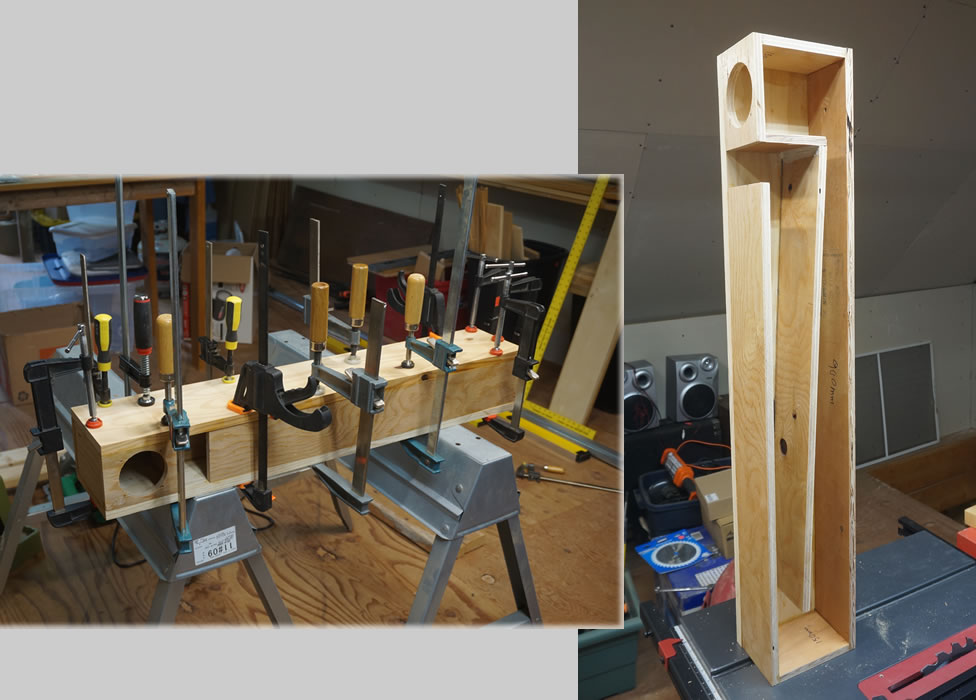
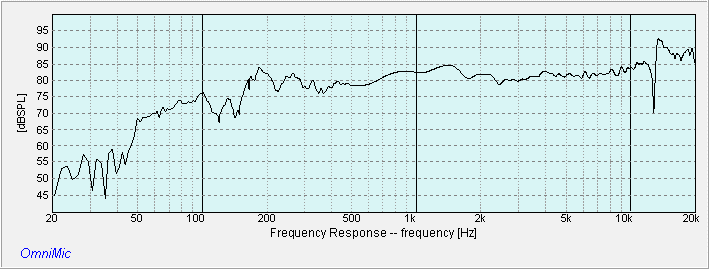 Fig 1 – PC83-8 Frequency Response
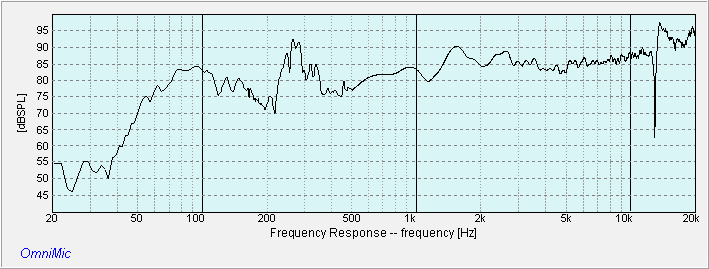 Fig 2 – PC83-8 TQWT Frequency Response
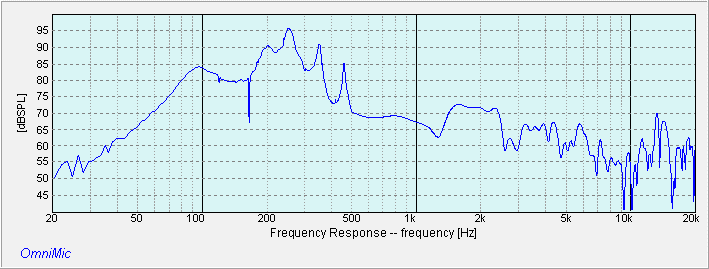 Fig 3 – PC83-8 TQWT Frequency Response