|
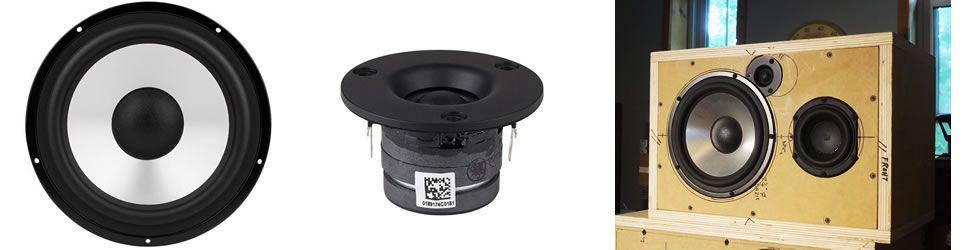
The Firebird is an affordable 3-way with the Peerless 830855 as the heart of the system. After testing her out in my previous post, it is now time to mate her with the Dayton DA215-8 and the Peerless DX20BF00-04 tweeter.
Since the 830855 is where everything centers around, I started working with her first. For an easier reference, I’ve attached the RAW response of the 830855 (Fig 1), Below that (Fig 2) is her BandPass response. Disregard the measurement below 500Hz. They include room reflections. I included this because I want to see the roll-off in the bass. As for the Low Pass, it’s nice to see the 9kHz peak is well suppressed. It will not interfere with the tweeter.
The Red plot in Fig 3 is the response of the Peerless DX20BF00-04 tweeter. Acoustically, the 830855 and the DX20 are crossing at 2.5kHz, the very frequency that I targeted. Now that the midrange and the tweeter is settled, it’s time to work on the bass.
Fig 4 is the DA215-8 with a 250Hz 2nd order Low Pass network. I’m quite pleased with the fairly steep roll-off. I do not expect the DA215 to affect the midrange with this Low Pass. Ideally, it would be better to cross at 125Hz but the crossover inductor would be enormous. It’s not an issue if I’m crossing actively but with a passive crossover, 250Hz is digestable.
.Fig 5 is a composite of the three drivers frequency responses. The critical midrange region is unaffected by the woofer and the tweeter. This should go a long way towards achieving clarity in the midrange.
Fig 6 is the summed response of the DA215, 830855 and the DX20BF. The Firebird is virtually flat from 1kHz~20kHz (+- 2.5dB).
In more than 20 years, I’ve never gotten a Waterfall plot such as this (Fig 7). The power bands (Red, Yellow, Green) are clearly layered. It shows the SPL decays evenly.
The light blue slices (stored energy) in Fig 8 are the artifacts seen in the Waterfall plot. The difference is the z-axis is now in cycles instead of time.
Fig 9 is the Spectrogram of the Firebird. This plot is a 2-D representation of the Waterfall and the Toneburst. From this plot, we can see all the artifacts above 2kHz have dissipated by 2 msec. The green streaks at 1.5kHz dissipated by 6 msec. I will not hear any peaking in the vocals.
This is where the Firebird is special. It appears she is Time-Aligned (Fig 10). Right at the start, we can see the tweeter’s phase is inverted (the sharp spike downwards). Immediately after, the plot shoots straight up. However, there’s only one positive peak at the top. Normally, there are two peaks, one for the midrange and after that, a second one which is the woofer. With a single peak, it means the DA215 woofer and the 830855 midrange are aligned. Incredible.
Lastly, Fig 11 is the Harmonic Distortion. The 2nd harmonic dominates from 1kHz~10kHz. That’s always a good sign. Distortion is fairly low. The 2nd is at -48.2dB below the fundamental while the 3rd is slightly lower at -51.0dB. Auditioning The main objective of a 3-way is bass. Otherwise, why bother. I started by playing tracks that are bass heavy. If there are any issues, this is where it’s going to be. In Stop, Look and Listen (Donna Summers), the bass attack is there. More than that, I detected some texture. The vocal is well separated from the bass. That’s important in a 3-way. The next track is Another One Bites the Dust (Queen). The bass is punchy, is textured and full bodied. Vocals again are well isolated. For recordings where the vocals are not in the foreground, I played There’ll Be Sad Songs (To Make You Cry) by Billy Ocean. The bass did not drown the vocals. Summary I am ecstatic with this Firebird. When I first started out, time-alignment was furthest from my mind. I was focused on separating the bass from the midrange. By the time I finished with her crossover, she ended up time-aligned. The Firebird not only measures well but sounds exceedingly natural. Bass is not overwhelming, midrange clarity is there and treble is not aggressive. An incredible performance for a budget build. Passive Bi-Amping the Firebird After listening to the Firebird for a few days, I can’t help but feel her bass is being held back. It is more obvious when I turned up the volume. Having thought over it, I decided to do a passive bi-amp. I disconnected the woofer network and wired it to the other channel of my power amplifier. The midrange and tweeter networks are still connected to the original channel. And what do you know, the bass came alive. Now, the Firebird really flies. One of the benefits of doing a passive bi-amping is I can adjust the volume of the bass separately because my amplifier has input pots. Since bass is greatly affect by the room and the speaker placement, I can lower the bass if it’s too much. The trade-off is you’ll need another power amplifier. Unless otherwise stated, all measurements were made in Full Space (4 pi) with the mic at 36 ins, midrange axis. Impulse Window=5ms. No smoothing applied. |
July 15, 2026Drivers Evaluation, HIFI DRIVERS
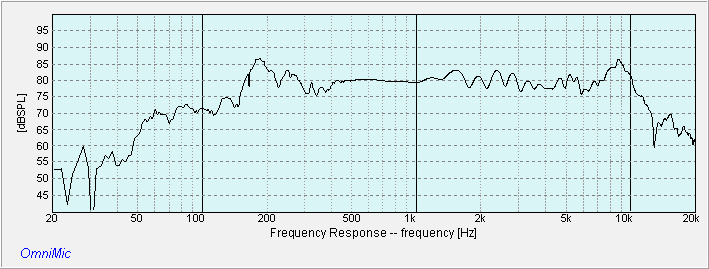 Fig 1 – Peerless 830855 RAW Frq Response • No Smoothing • Mic on axis with 830855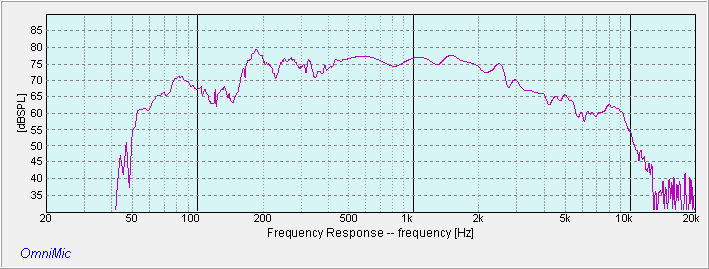
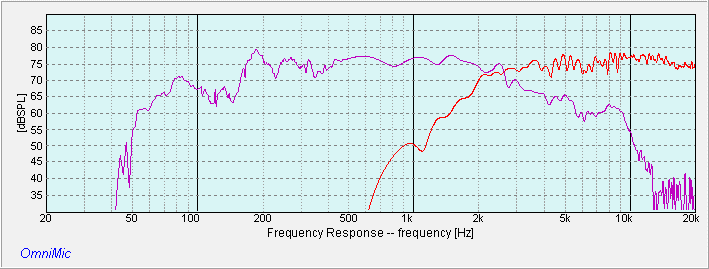 Fig 3 – Peerless 830855 BandPass • DX20BF High Pass
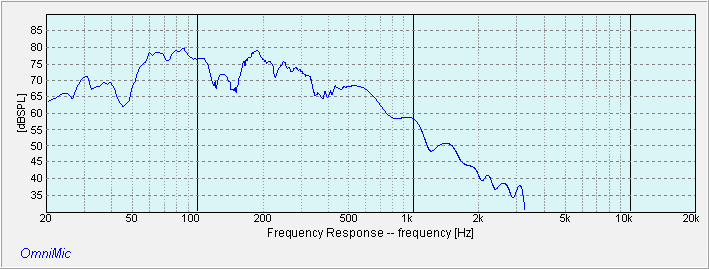 Fig 4 – Dayton DA215-8 with Low Pass
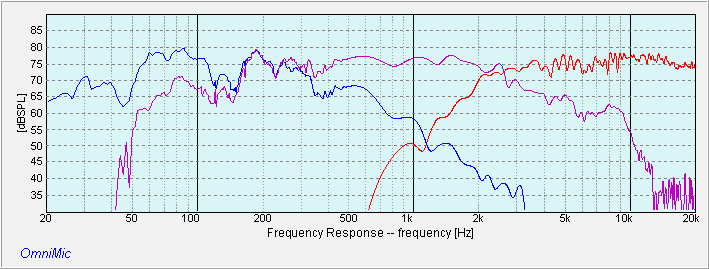 Fig 5 – Dayton DA215-8 with Low Pass • 830855 BandPass • DX20BF with High Pass
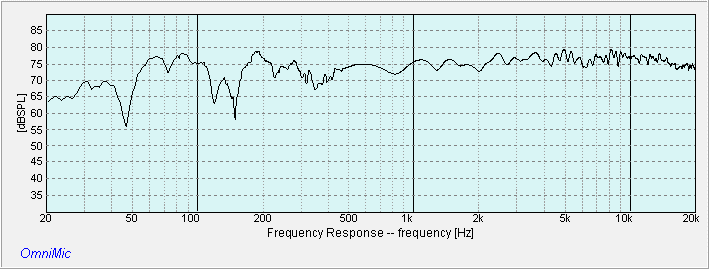 Fig 6 – Firebird Frequency Response
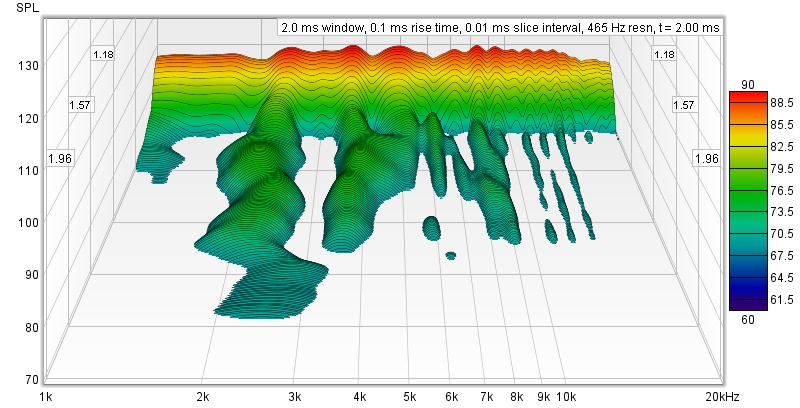 Fig 7 – Firebird Waterfall
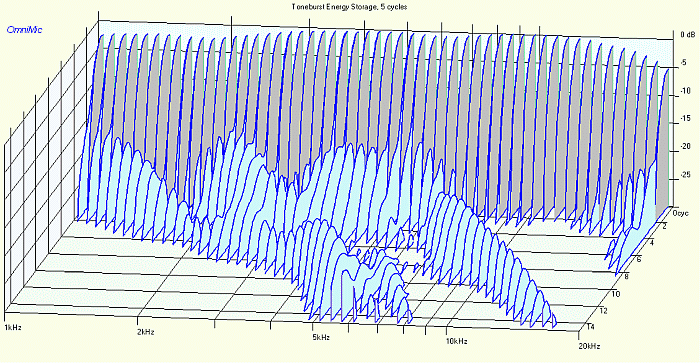 Fig 8 – Firebird Toneburst Energy Storage
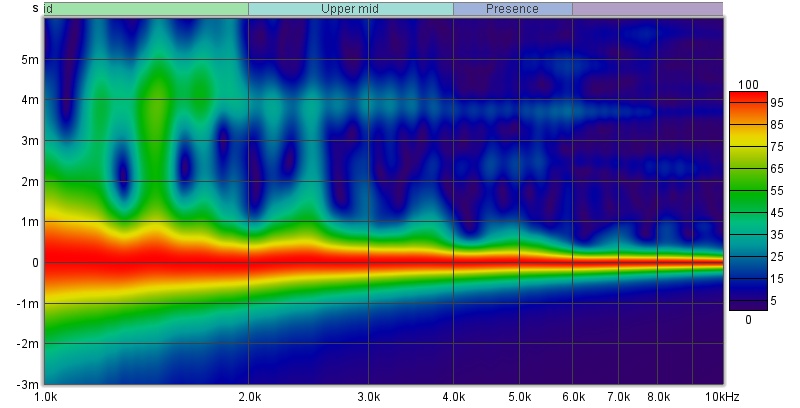 Fig 9 – Firebird Spectrogram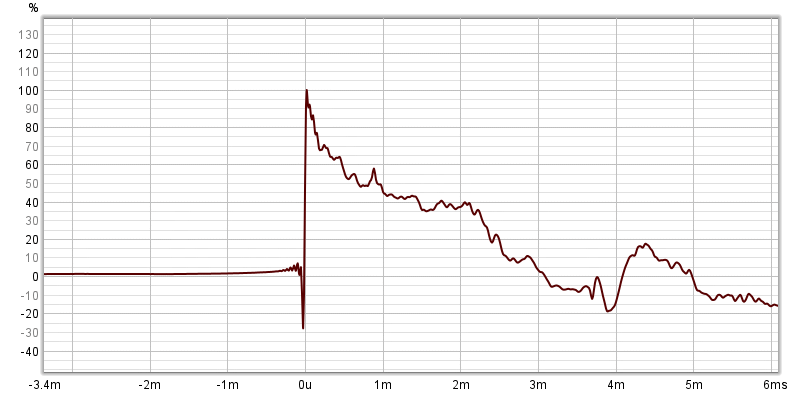
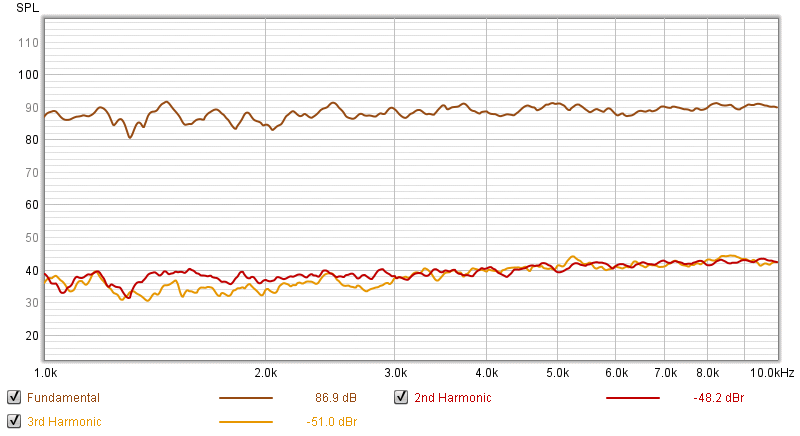 Fig 11 – Firebird Harmonic Distortion