|
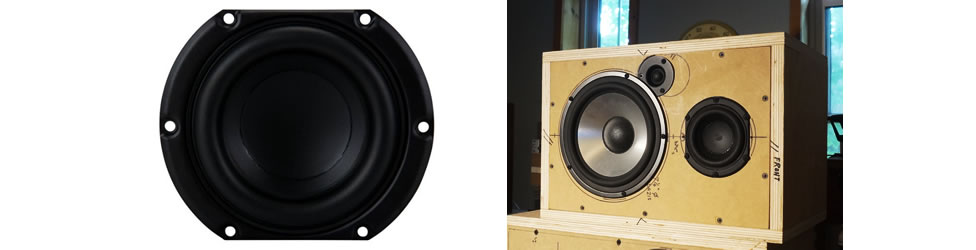
This Peerless 830855 is a budget 4″ woofer that belongs to their SDS family. It was designed to be used as a compact subwoofer, a woofer in a 2-way or a midrange in a 3-way system. In this post, she serves as a midrange driver in a 3-way (see photo above). Behind the 830855 is a 2.5 liters sealed chamber stuffed with Poly-fil. Bass is assigned to an 8″ Dayton DA215-8 aluminum cone woofer loaded onto a 27 liters Bass Reflex. A Peerless DX20BF00-04 tweeter takes care of the treble. Peerless Frequency Response Fig 1 is the RAW response of the 830855. No crossovers are used in this measurement. Please note the plot below 500Hz includes room reflections. We can see the woofer goes down to 60Hz (-10dB) below the fundamental. This is in free-space (4pi). Another notable feature is the absence of a baffle step. She is essentially flat from 500Hz~7kHz. What is interesting are the wriggles from 1.5kHz~3kHz. It indicates there’s a bit of ringing in the cone. In other words, the cone is not sufficiently damped. I doubt this is audible but they are clearly visible. At 6kHz, she starts to experience cone breakup, culminating with a peak at 9kHz.
The Waterfall plot (Fig 2) shows artifacts at 9kHz and the initial cone ringing at 1.5kHz.
The Toneburst plot (Fig 3) expresses the artifacts (Stored Energy) as light blue slices. The slices from 1.5kHz~3kHz are the most concerning. Those higher up like 9kHz are quite benign because the z-axis is now in cycles and not time.
The Spectrogram in Fig 4 gives a clearer view of the artifacts. The ringing can be seen from 1.5kHz~3kHz. They are the green streaks bleeding upwards. Fortunately, they are not destructive because they dissipated by 6 msec. From 3kHz onwards, all artifacts dissipated by 1 msec.
The Step response in Fig 5 is quite revealing. Note the series of peaks in the decay. This is the “Ringing” seen in Fig 1. After the 3rd peak, the ringing stops and the woofer decays gracefully.
The 830855 Harmonic Distortion (Fig 6) shows the 2nd Harmonic is -51.9dB below the fundamental. The 3rd is very slightly lower at -52.1dB. From 4kHz~10kHz, the 3rd dominates but that is not an issue because I intend to cross at 2.5kHz. Auditioning I am evaluating this 830855 strictly as a midrange driver. I intend to cross her at about 250Hz and 2,500Hz. The focus is on voices. In John Denver’s My Sweet Lady, he sounds perfect. Not shouty at all. The emotions come across. Up next is Amapola by Andrea Bocelli. One cannot help but be swept by his soaring voice. No issues detected. Lastly, an oldie from 1972, Oh Girl by the Chi-Lites. Brings back lots of memories. Summary The Peerless 830855 is extremely affordable at $18 (Parts Express). However, don’t expect her to perform like the Peerless 830870 or the vintage M11MG09-08 by Vifa. For the same price, the TG9FD10-08 is a far better option. Since I’ve already mounted her in a 3-way, I shall continue my evaluation, this time with her crossover installed. After all, that’s what she ultimately will be used for. With the bass and treble added, I can then hear her midrange in her intended use. Unless otherwise stated, all measurements were made in Full Space (4 pi) with the mic at 36 ins, tweeter axis. Impulse Window=5ms. No smoothing applied. |
July 9, 2026Drivers Evaluation, HIFI DRIVERS
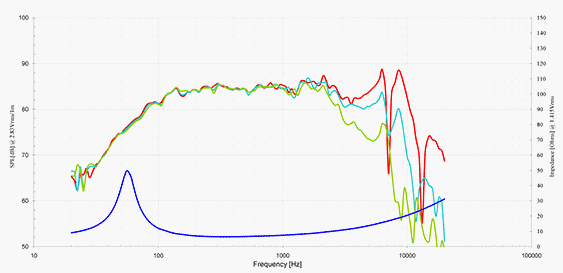
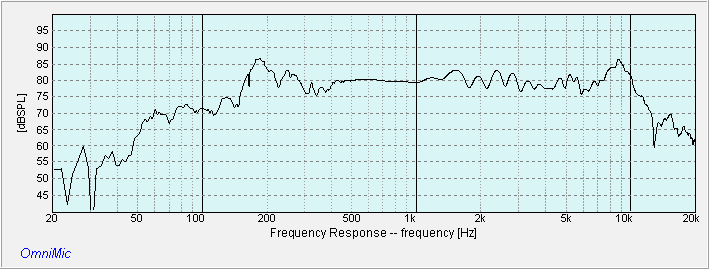 Fig 1 – Peerless 830855 Frq Response • No Smoothing • Mic on axis
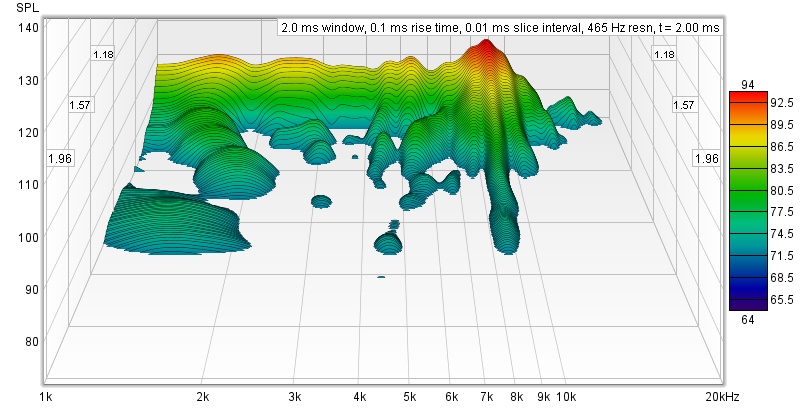 Fig 2 – Peerless 830855 Waterfall
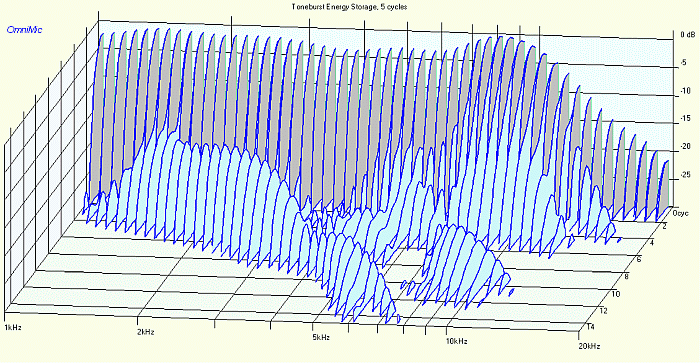 Fig 3 – Peerless 830855 Toneburst Energy Storage
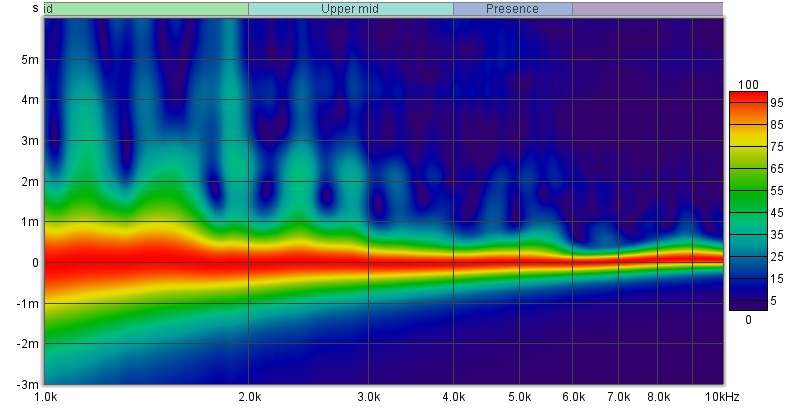 Fig 4 -Peerless 830855 Spectrogram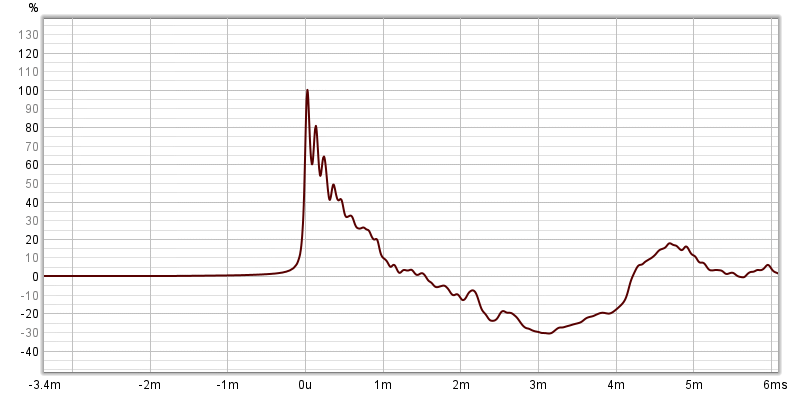
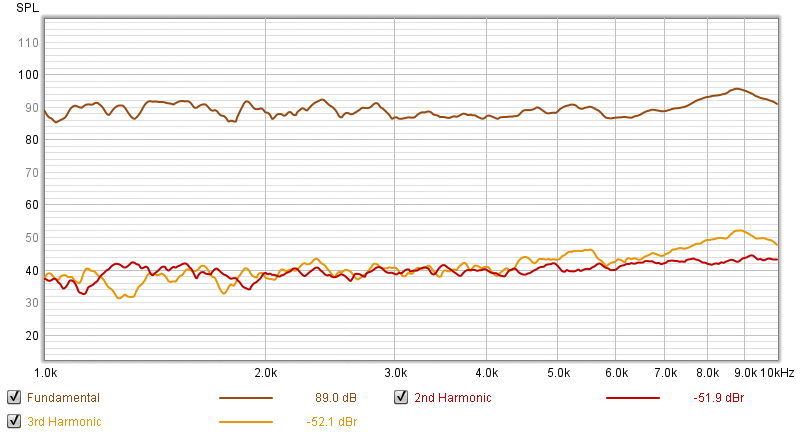 Fig 6 -Peerless 830855 Harmonic Distortion